With over 20 years of experience, we transform your digital presence. We specialize in website and E-Shop development, SEO and Digital Marketing, ERP software and smart automation that take your business to the next level.
EV pickup and e-commerce: why Slate Automotive's move deserves your attention
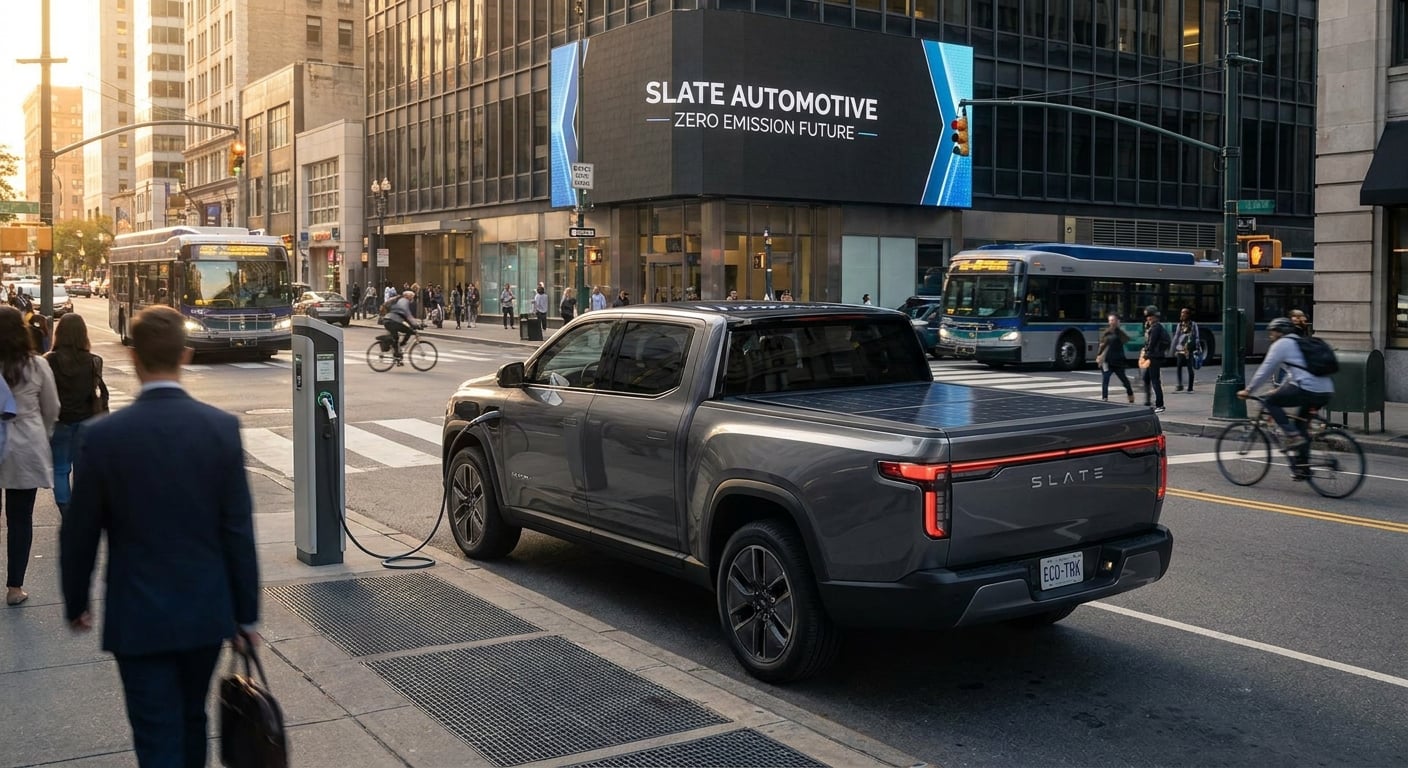
The new image gallery published by Slate Automotive for its compact EV pickup is not just another automotive update. For an e-shop owner, it’s a clear example of how a product can be presented as a platform, experience, and sales ecosystem, even before it reaches the mass market. The DesignNews article focuses on the vehicle’s new visual presentation: a small, minimalist, electric pickup built around the concept of a “blank slate,” a basic product that the customer can customize with accessories, wraps, kits, and functional upgrades.
This thinking model is particularly useful for e-commerce. Many e-shops still treat the product as a single SKU on a catalog page. Slate, by contrast, shows how an EV pickup can be sold as a use case: today it’s a daily commute tool, tomorrow a commercial delivery vehicle, the day after tomorrow a basis for customization. The value is not limited to the electric pickup itself, but extends to the aftermarket, EV accessories, car accessories e-shop, custom vehicle wraps, and any additional services that create recurring demand.
For e-commerce owners, the real question isn't whether they'll sell cars. It's whether they can adopt the logic of a modular product design: a central product, multiple configurations, smart visualization, pre-orders, content that answers objections, and a funnel that turns curiosity into qualified demand.
What the new Slate Automotive gallery shows
Slate Automotive presents its EV pickup as a simple, clean and affordable electric truck, designed to give the user the feeling of being able to customize it. The DesignNews publication highlights the importance of image: the vehicle is shown from multiple angles, in different configurations and with an emphasis on practicality. Its very aesthetic is not based on exaggeration, but on the idea that the product is “open” to change. This is a great visual merchandising lesson for e-shops that sell products with variations, parts, bundles or accessories.
The most interesting commercial element is that the Slate EV pickup is being marketed with a base range of about 150 miles and an optional battery that goes up to about 240 miles, according to data released around the model’s launch. This information isn’t just a technical feature. It’s a decision-making point. A consumer thinking about daily commutes might consider 150 miles to be plenty, while a professional making deliveries or moving out of town will evaluate the upgrade differently. In e-commerce, such differences should translate into a clear comparison, not get lost in long descriptive blocks.
As shown in the chart below, the difference between the basic and optional battery life versions creates a simple but powerful upsell narrative: “enough for everyday use” versus “more flexibility for professional or extended use.”.
Slate EV Pickup range by version
Source: Slate Automotive launch information and DesignNews
150 miles
Basic version
240 miles
Optional battery
For an e-shop, the corresponding application is clear: don’t present the versions of a product as a simple list of options. Show what changes in the customer’s daily life. Whether you sell logistics equipment, tools, electric bikes, automotive accessories or technology devices, each upgrade should be linked to a practical use scenario, not just a technical number.
The rise of electric vehicles as a signal for new commercial ecosystems
The interest in Slate’s EV pickup is not in a vacuum. The global market for electric vehicles has grown rapidly. According to the International Energy Agency, global sales of electric cars increased from about 3 million in 2020 to about 14 million in 2023, and exceeded 17 million in 2024. This means that electric vehicles are no longer a niche for early adopters. They are creating new categories of demand: chargers, cables, cabin organizers, bed protectors, smart accessories, software subscriptions, cleaning products, distribution equipment and support content.
For an e-shop that is active in automotive ecommerce or thinking about entering related categories, the question is not just “what product will I sell?” The right question is “at what point in the EV customer’s lifecycle can I offer value?” The new owner of an electric pickup needs training, compatible accessories, installation guides, personalization options and after-sales support. That’s where margins are created.
The trend is clearly visible in IEA data on global electric car sales.
Global electric car sales
Source: IEA Global EV Outlook 2024 and 2025
The speed of development explains why a product like the Slate EV pickup has commercial appeal beyond the automotive industry. When a market grows this fast, it’s not just manufacturers who benefit. It’s those who create content, comparison pages, marketplaces, specialized bundles, and services around new buyer needs. Even if your e-shop doesn’t sell vehicles, it can sell solutions for electric vehicle owners.
What e-shops can learn from Slate's direct-to-consumer model
Slate Automotive seems to be moving with a direct-to-consumer automotive logic: strong visual presentation, clear positioning, simplified core proposition and the ability to personalize. This looks more like a modern e-commerce brand than a traditional automotive launch. The product works like a canvas. The customer is not just buying a vehicle, but the promise that they can customize it according to their personality or work.
This approach touches on a crucial issue: the product configurator. In an e-shop, especially when there are many options, the customer needs to quickly understand what suits them. A bad configuration experience kills conversion. If the user has to open five tabs, read technical PDFs and guess which accessory is compatible, they are likely to leave. On the contrary, a well-designed configurator can increase the average order value, reduce returns and make the upsell seem useful, not pushy.
The second practice is the pre-order funnel. A product that is not yet fully available can build demand if its communication is specific. It needs a landing page with a clear promise, FAQ that answers concerns, images of real uses, email capture, refundable deposit where appropriate, and segmentation by purchase intent. Slate's EV pickup has enough elements that make the user imagine themselves inside the product. This is exactly what an e-shop should do when launching a new line.
The third practice is ecosystem thinking. If you sell a core product, plan for peripheral products early on. For example, an e-shop selling automotive products can create categories for EV accessories, charging cables, organizers, anti-slip, protectors, harsh chemical-free cleaners, products for professional distributors, and sustainable last mile delivery drivers. The value lies in connecting products to each other.
Step-by-Step: how to turn a trend like the EV pickup into sales
The trend alone is not enough. Many e-shops see a growing market, quickly upload a few products and wait for organic demand. This rarely works. It takes a structured process that connects keyword research, commercial analysis, content and conversion optimization. Here is a practical plan to capitalize on a trend like the EV pickup without investing blindly.
Step 1: Map the search intent. The Focus Keyword “EV pickup” has high commercial and informational value, but it’s not enough. Create clusters around terms like electric pickup, electric truck, Slate Automotive, EV accessories, car accessories e-shop, and automotive ecommerce. One user is looking for a new vehicle, another for accessories, another for information about autonomy, and another for a business solution for deliveries. Each intent needs a different page or section.
Step 2: Create landing pages per use case. Don’t limit yourself to a general category like “EV accessories.” Create pages like “Accessories for electric pickup trucks,” “Equipment for professional EV deliveries,” “Truck organization products,” or “Charging solutions for everyday use.” Each page should have its own copy, internal links, products, FAQ, and schema where possible.
Step 3: Use visual merchandising with a gallery approach. Slate doesn’t just present technical specs. It builds visuals that help the customer understand what the product looks like in use. An e-shop can do the same with before-and-after photos, installation images, size comparisons, 30-second videos, 360 views, and user-generated content. The more expensive or technical the product, the more important visual proof becomes.
Step 4: Design problem-based bundles. If someone is buying accessories for an EV pickup, they probably need more than one product. Create bundles like “daily charging starter kit,” “delivery kit,” “body protection kit,” or “personalization kit.” This way you increase the average order value without pushing the customer to buy unrelated products.
Step 5: Measure with commercial KPIs. Track organic clicks per cluster, conversion rate per landing page, accessory attach rate, add-to-cart rate on bundles, returns due to incompatibility, and revenue per email segment. If the EV pickup trend is driving traffic but not sales, perhaps the content is too informative and not commercial enough. If it’s driving good conversions but low AOV, perhaps bundles and cross-sells are missing.
In the US market, Cox Automotive data shows that the share of EVs in new sales has gradually increased in recent years, reaching about 8.1% in 2024. For e-shops, this means that the audience is growing, but still needs education, comparison and trust before purchasing products related to electric vehicles.
EV share of new vehicle sales in the US
Source: Cox Automotive / Kelley Blue Book EV sales reports
Conclusion: the EV pickup as a case study of commercial thinking
Slate Automotive’s new material serves as a reminder that products don’t win on features alone. They win when they are presented with a clear market position, easy to understand, a strong image and the ability to be personalized. The EV pickup is technically interesting, but for e-shop owners, what matters most is its commercial architecture: a core product that opens up space for accessories, services, content, community and repeat sales.
If you run an e-shop, it’s worth seeing Slate not just as automotive news, but as a practical lesson. Look at your own categories and ask yourself: what is your “blank slate” product? Which products can become an ecosystem? Where do you need a better product configurator? Which pages should be built around use cases instead of general categories? And most importantly, how can you help the customer imagine the use before they click “buy”? Therein lies the difference between a simple online store and a brand that truly capitalizes on trends.
Slate Automotive's EV pickup is a compact electric pickup truck designed for customization. It offers a base range of 150 miles with the option to upgrade to 240 miles.
How does Slate's EV pickup relate to e-commerce?;
Slate's model shows how a product can be sold as a platform and experience, emphasizing customization and complementary products, which is useful for e-shops.
What is the importance of visual presentation in EV pickup?;
The visual presentation of the EV pickup highlights the vehicle's customization capabilities, offering customers images of various configurations, which is an important lesson for visual merchandising in e-shops.
How does Slate's EV pickup support the idea of modular product design?;
The EV pickup functions as a basic product that can be customized with accessories and upgrades, approaching the logic of modular design that is critical for modern e-commerce.
What is the commercial appeal of Slate's EV pickup?;
The EV pickup is presented with strong positioning and personalization capabilities, which makes it attractive to various customer categories, while creating new opportunities for aftermarket products and services.
How can e-shops benefit from Slate's direct-to-consumer model?;
E-shops can learn from Slate's model by focusing on strong visual presentation, simplified proposition, and personalization capabilities, thus improving the overall customer experience.
Why are EV pickups a commercial opportunity for e-shops?;
The growing demand for electric vehicles is creating new needs for accessories and services, offering e-shops the opportunity to expand their range and meet these needs.