With over 20 years of experience, we transform your digital presence. We specialize in website and E-Shop development, SEO and Digital Marketing, ERP software and smart automation that take your business to the next level.
Why sensors became a strategic tool for e-commerce
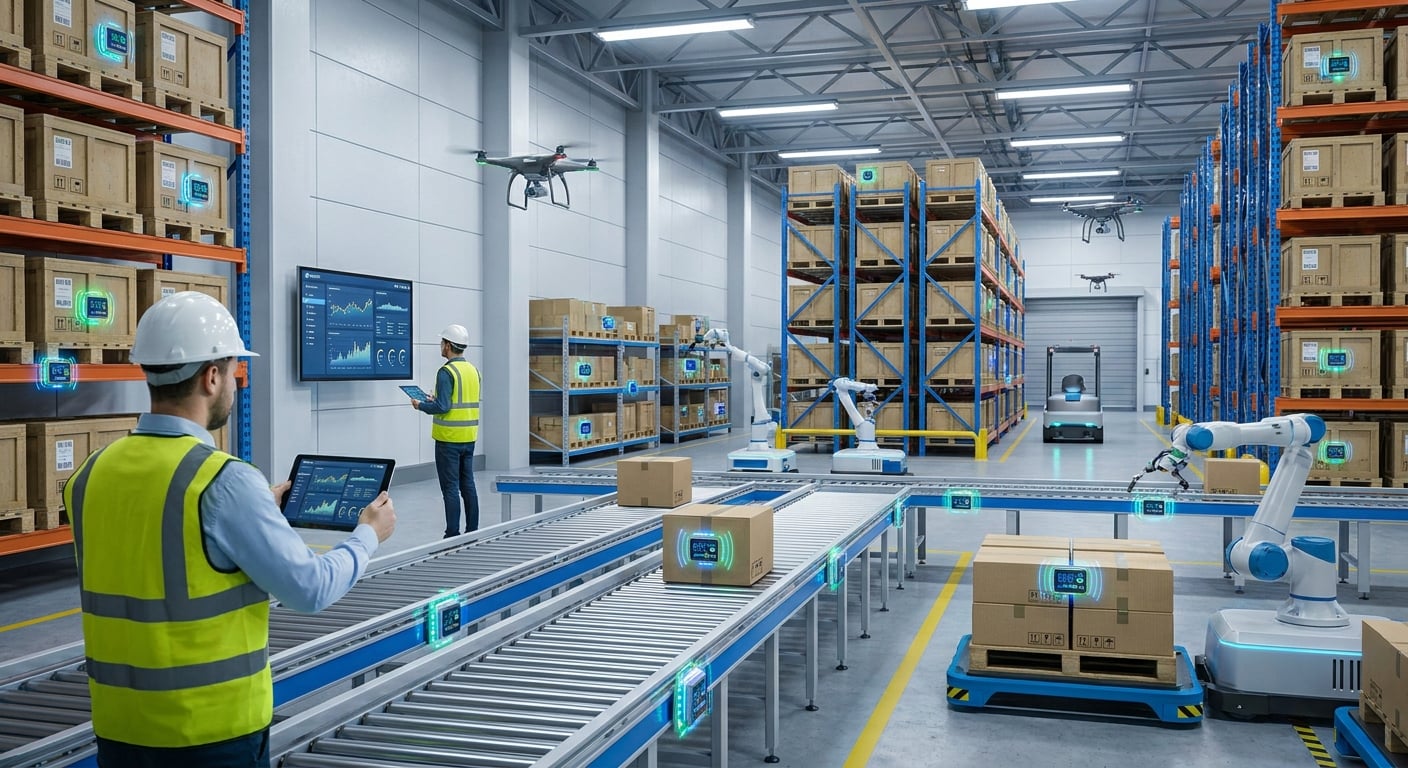
Sensors are no longer a technical topic that concerns only industrial engineers or hardware manufacturers. For an e-commerce owner, sensors can directly impact inventory accuracy, fulfillment speed, delivery quality, customer experience, and ultimately gross profit margin. DesignNews’ article on the most important innovations in sensors highlights a broader shift: devices are becoming smaller, smarter, more energy-efficient, and more connected. This means that technologies that just a few years ago seemed out of reach for an SMB, such as computer vision in the warehouse, RFID sensors at the item level, IoT sensors in refrigerators or distribution vehicles, and edge AI for instant decision-making, are now on the radar of e-commerce teams.
The practical value lies in the fact that sensors convert physical events into actionable data. A product is or is not on the shelf. A pallet is moving or is stationary. A package has been exposed to an out-of-range temperature. A warehouse aisle is congested. A packaging machine exhibits a vibration pattern that warns of a failure. Without sensors, all of this is noticed late, often when costs have already been incurred: order cancellation, return, negative review, shipping delay or lost inventory. With proper installation, smart sensors create a real-time functional layer on top of ERP, WMS, e-shop and marketing automation tools.
The rise of connected devices shows why this is not a theoretical issue. According to IoT Analytics, global connected IoT devices will reach approximately 18.8 billion in 2024, up from 14.4 billion in 2022, with a forecast of approximately 40 billion by 2030. For e-shops, this growth means more available solutions, lower cost per sensor, and more ready-made integrations with cloud platforms, WMS, and analytics dashboards. As the chart below shows, the market direction is clearly upward.
Global growth of connected IoT devices
Source: IoT Analytics, State of IoT 2024 and predictions to 2030
Five innovations in sensors that an e-shop should monitor
The first major innovation is the maturation of MEMS sensors, i.e. microelectromechanical sensors that measure motion, acceleration, pressure or orientation with a very small size and low consumption. In e-commerce, this translates into more economical trackers for boxes, pallets, vehicles and warehouse equipment. The second is the progress in temperature and humidity sensors, critical for brands that sell food, cosmetics, pharmaceuticals, supplements or sensitive materials. If a product must be kept within a specific temperature range, knowing after delivery that there was a problem is too late. The goal is real-time notification and documentation of the cold chain.
The third innovation is the use of LiDAR and advanced optical sensors for spatial perception. In large warehouses or dark stores, LiDAR can help robots, autonomous mobile robots and security systems map the space, avoid obstacles and move with greater precision. The fourth is computer vision, i.e. the use of cameras and algorithms to identify objects, measure shelf fullness, check for picking errors and confirm packaging. The fifth, and perhaps most decisive, is edge AI: instead of all data being sent to the cloud, some of the analysis is done locally, on the device or in a nearby gateway. This reduces latency, limits the volume of data transferred and allows decisions to be made in real time, such as stopping a packaging line when the wrong product is detected.
Air quality sensors and biometric sensors also play an important role in environments where health, safety and compliance are of particular importance. In a warehouse with personnel, lithium batteries, cold storage or high machine traffic, monitoring environmental data is not just a “nice to have”. It can reduce risks, document processes and protect both people and the brand. At the same time, security sensors, from smart cameras to access detectors, can be connected to loss prevention policies and audit trails.
From RFID and real-time inventory tracking to automated fulfillment
For most e-shops, the most immediate scope is inventory. The discrepancy between “available in the system” and “actually available on the shelf” is one of the most expensive invisible enemies of e-commerce. It creates overselling, cancellations, delays, manual checks and a poor customer experience. Here RFID sensors have proven measurable value, because they allow for rapid scanning of many products without visual contact, unlike traditional barcodes that require a more manual process. Item-level RFID can serve as the basis for real-time inventory tracking, especially in categories such as fashion, footwear, electronic accessories and premium products.
An often-cited finding from research by the Auburn University RFID Lab and partners is that typical retail inventory accuracy can be around 63%, while with item-level RFID it can be around 95%. For an omnichannel e-shop, this difference is not just functional; it affects conversion rate, because the customer sees more reliable availability, and performance marketing, because you are not driving paid traffic to products that ultimately cannot be shipped. The chart below captures the difference in a simple way.
Inventory accuracy with and without item-level RFID
Source: Auburn University RFID Lab / GS1 US, data on item-level RFID in retail
63%
Standard accuracy without RFID
95%
Accuracy with item-level RFID
Automation doesn’t stop at RFID. Logistics sensors are now connected to robotics systems, scales, conveyors, smart lockers, thermal printers and sorting systems. According to the International Federation of Robotics, annual installations of industrial robots worldwide have remained at very high levels in recent years, with 541 thousand new installations in 2023 after a historic high of 553 thousand in 2022. This is important for e-commerce because robotic applications rely on sensors to “see”, move and collaborate with humans. As installations grow, so does the availability of fulfillment solutions that can be adopted gradually, without requiring a full robotic warehouse from the start.
Annual installations of industrial robots worldwide
Source: International Federation of Robotics, World Robotics 2024
Step-by-Step guide to implementing sensors in an e-shop
The right approach is not for a business to buy sensors because the technology is impressive. It is to start with a specific business problem. Step 1: document where money or time is being wasted. Examples are stockouts, cancellations due to incorrect inventory, picking delays, returns due to poor packaging, product deterioration due to temperature, theft or equipment damage. Step 2: define a KPI before selecting technology. For example, “reduce inventory cancellations by 30%”, “increase inventory accuracy by over 95%”, “reduce stock count time by 50%” or “document temperature for 100% of refrigerated shipments”.
Step 3: Choose the sensor category based on the use. If the issue is product accuracy, consider RFID sensors. If it’s transport quality, start with temperature, humidity, and impact sensors. If it’s picking speed, consider computer vision, smart shelves, or scanners connected to a WMS. If it’s equipment maintenance, use vibration, current, and heat sensors for predictive maintenance. Step 4: Design a small 60- to 90-day pilot in a product category, warehouse zone, or order flow. The pilot should have a clear baseline, not vague promises. Measure before and after.
Step 5: Check the integrations. Sensors only have value when the data reaches where decisions are made: in the ERP, WMS, e-commerce platform, CRM or a BI dashboard. If the information stays in a separate portal that no one monitors, the project will fail. Step 6: Train the warehouse and customer support team. People need to know what each alert means, who takes action and when an alert is critical. Step 7: Calculate ROI based on real losses. Factor in reduced cancellations, less manual inspection, lower write-offs, fewer returns and a better customer experience. Step 8: Scale only what has proven value. A good sensor project is not a technology showcase; it is a mechanism for continuous improvement.
Security, ROI and points to consider before investing
The more sensors are connected to the enterprise, the greater the need for data security. IoT sensors, gateways and cloud platforms must be treated as part of the overall cybersecurity of the e-shop. This means strong device identification, encryption, firmware updates, network separation, role-based access and a clear data retention policy. It’s no exaggeration: according to IBM, the average cost of a data breach will reach $4.88 million in 2024, the highest level its study has ever reported. For a small to medium-sized business, even a much smaller incident can cause downtime, loss of trust and legal repercussions. The chart below shows the upward trend in the average cost of a breach.
Average global cost of a data breach
Source: IBM Cost of a Data Breach Report 2020-2024
Beyond security, there is also the issue of data quality. A sensor that is not properly calibrated, an RFID tag placed in the wrong place, or a camera affected by poor lighting can produce false readings. This is why a verification process is needed, not just a simple installation. The business must define who monitors the KPIs, how maintenance is done, when batteries are replaced, and how exceptions are handled. Particular attention is also needed to privacy, especially when using cameras, biometric sensors, or employee tracking systems. Technology should serve productivity and security, not create vague or excessive monitoring.
To properly assess ROI, an e-commerce owner must look beyond the purchase cost. There are costs for installation, software, connectivity, maintenance, training, and possibly process changes. On the other hand, there are benefits that are often greater than they initially appear: fewer picking errors, fewer returns, fewer lost man-hours on inventories, better warehouse utilization, faster customer service, and better reliability of delivery promises. The soundest approach is to start with an operation with high repeatability and a clear cost of error. That’s where sensors can quickly prove their worth.
Conclusion: sensors as a competitive advantage
Sensors are evolving from “technical components” to strategic infrastructure for e-commerce. Their real power lies not only in measurement, but in the connection of measurement, decision and action. An e-shop that knows precisely where the product is, what condition it is in, when a process is at risk and where bottlenecks occur, can operate with fewer assumptions and more data. This is especially important in a market where the customer expects immediate availability, fast shipping, transparency and consistency.
The best time for a business to consider sensors is not when it has grown so much that errors have become uncontrollable. It is when it can still design its processes properly and scale with discipline. Start with a problem, choose a measurable KPI, run a small pilot, and connect the data to the systems your team already uses. This way, sensors, IoT, edge AI, and real-time inventory tracking don’t just stay at the level of a technology trend. They become a practical advantage that reduces costs, protects the customer experience, and helps your e-shop grow with greater precision.
Sensors improve inventory accuracy, fulfillment speed, and delivery quality, positively impacting customer experience and gross profit margin.
How do RFID sensors help in inventory tracking?;
RFID sensors enable fast and accurate scanning of products without visual contact, improving inventory accuracy and reducing order cancellations.
What are the latest innovations in sensors for e-commerce?;
Innovations include MEMS sensors, temperature and humidity sensors, LiDAR, computer vision and edge AI, enabling better real-time monitoring and decision-making.
What are the basic steps for implementing sensors in an e-shop?;
Start by recording problems, define KPIs, select the appropriate technology, design a small pilot, and ensure that data is integrated into existing systems.
How do sensors help reduce costs and increase efficiency?;
By using sensors, picking errors, returns and lost man-hours are reduced, while inventory reliability and customer experience are improved.
What is the importance of data security for sensor-based e-commerce?;
Data security is critical, as sensors are part of the overall cybersecurity of the e-shop, requiring encryption and strong authentication.