With over 20 years of experience, we transform your digital presence. We specialize in website and E-Shop development, SEO and Digital Marketing, ERP software and smart automation that take your business to the next level.
Why IoT is not a technical detail, but a commercial risk for every e-shop
For an e-commerce owner, IoT often sounds like a topic that concerns industries, telecommunications providers or hardware manufacturers. In practice, however, IoT is already embedded in the daily operation of e-commerce: in wireless POS that completes payments at physical pickup points, in smart lockers, in warehouse tablets, in temperature sensors for sensitive products, in picking scanners, in last mile vehicles and in remote monitoring systems. When these points rely on cellular IoT, i.e. a connection via mobile phone networks, the quality of the signal translates directly into the quality of service. A checkout that does not complete, a locker that does not synchronize orders or a vehicle that loses its position is not just a technical problem; it is a cost, a lost trust and a potential loss of a repeat customer.
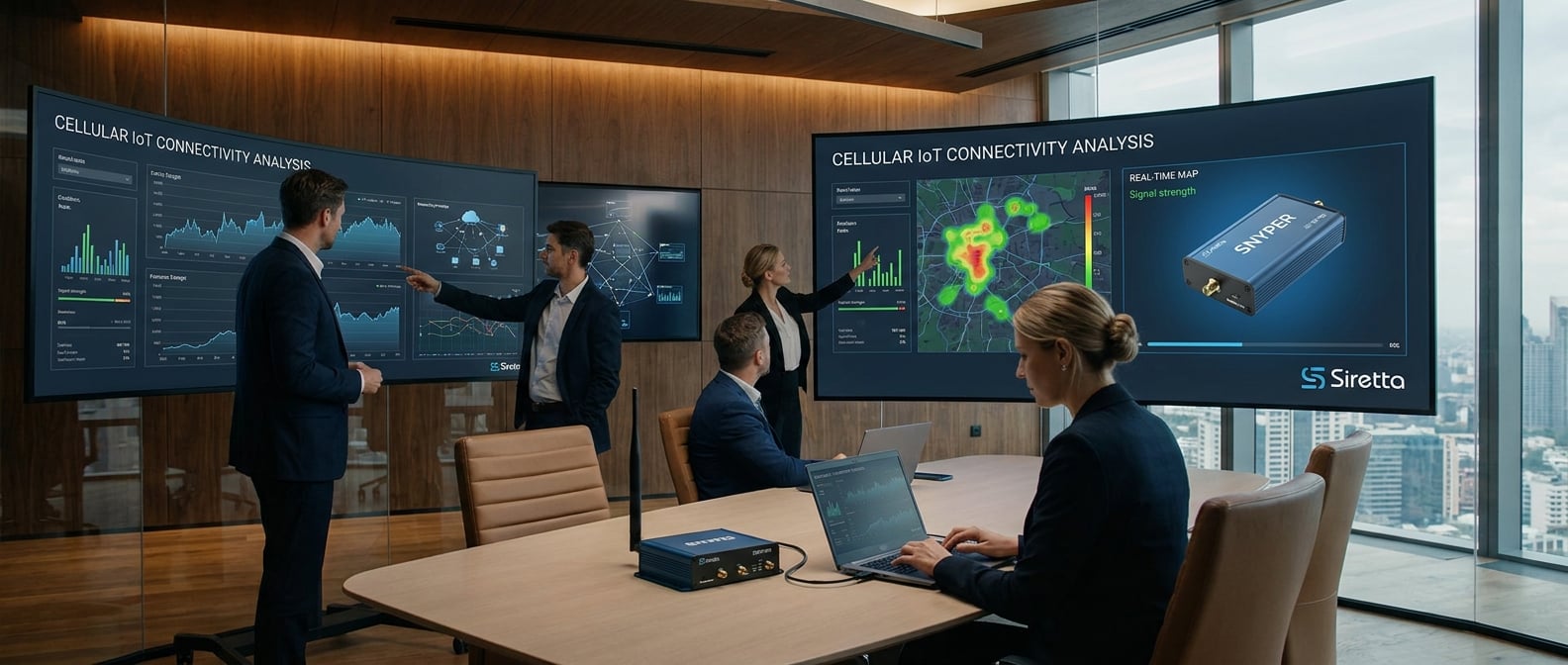
The DesignNews article on surveying cellular networks using Siretta SNYPER highlights exactly this logic: before a business installs equipment that depends on 4G LTE or 5G, it needs to know which provider, which technology and which installation point offer the most stable connection. For e-commerce businesses investing in automation, warehousing, click and collect or e-commerce logistics, network coverage should not be assessed “by eye” from the bars of a mobile phone. An organized network survey is needed, with measurements such as RSRP, RSRQ and SINR, so that decisions about IoT SIM card, router, antenna and provider are based on data.
What does the case of Siretta SNYPER teach us?
Siretta SNYPER is a specialized cellular network analyzer used to scan available mobile networks in a specific location. Its practical value lies not only in “seeing” if there is a signal, but in helping a business compare providers, technologies and connection quality before purchasing or installing equipment. For an e-shop that opens a new pickup point, relocates a warehouse or installs lockers in a commercial space, this information can prevent wrong choices that later cost more: provider changes, replacement routers, external antennas, go-live delays and customer complaints.
The bottom line is that IoT requires a different way of evaluating than simple mobile browsing. An employee can tolerate a few seconds of slow internet on their mobile phone. However, an M2M system that updates real-time stock, temperatures, order statuses or POS transactions does not have the same tolerance. POS connectivity, for example, needs to be predictable, not just available. If the signal is weak at the checkout, if the router is in a metal rack or if the warehouse has “dead zones”, the customer experience is affected without being immediately visible on the e-shop dashboard. Therein lies the business value of a network survey: it brings problems to the surface before operational failures occur.
Market data shows why connectivity is becoming critical
The IoT debate is not theoretical. According to IoT Analytics, the global number of connected IoT devices was estimated at 16.6 billion in 2023, 18.8 billion in 2024, and is projected to reach approximately 40 billion by 2030. This means that more and more retail outlets, warehouses, vehicles, and service systems will compete for reliable connectivity. For the e-shop owner, the message is simple: as the ecosystem of connected devices grows, the more important it becomes to design the infrastructure professionally and not piecemeal.
As shown in the graph below, the growth of IoT devices is intense and creates new levels of dependence on stable networks, proper installation, and continuous monitoring.
Global connected IoT devices
Source: IoT Analytics, State of IoT 2024
At the same time, the transition to 5G raises expectations for speed, lower latency and better management of multiple devices. Ericsson says that global 5G subscriptions are expected to reach about 2.3 billion by the end of 2024 and 6.3 billion by 2030. This does not mean that every e-shop needs 5G on every device immediately. But it does mean that subsequent investments in routers, modems, gateways and IoT SIM cards must be made over a multi-year horizon. If a business deploys infrastructure today only based on the minimum need, it may soon find itself with limitations on remote monitoring, real-time logistics or automated warehouse operations.
The following chart shows the projected rise in 5G subscriptions, which explains why equipment and provider selection must take into account not only current costs, but also future scalability.
Global 5G subscriptions
Source: Ericsson Mobility Report, November 2024
2.3 billion.
2024
6.3 billion.
2030
Another useful context comes from the GSMA, which in its State of Mobile Internet Connectivity Report 2024 states that at the end of 2023, 571% of the global population used mobile internet, 391% were in coverage but not using it, and 41% remained outside mobile broadband coverage. For e-commerce brands considering international expansion, cross-border logistics or pickup points in less central areas, this shows that coverage is not a given everywhere in the same way. Even when coverage is available, the actual quality inside a building or warehouse can vary significantly.
The chart below captures the difference between connectivity, coverage, and coverage gap, a distinction that is critical when designing infrastructure for e-commerce operations.
Mobile internet status worldwide
Source: GSMA State of Mobile Internet Connectivity Report 2024, end-2023 data
Mobile internet users57%
They are covered but not used39%
Out of mobile broadband coverage4%
Where does the risk lie in the daily operation of an e-shop?
The biggest mistake many businesses make is that they treat connectivity as a commodity, not as a functional infrastructure. They buy a router, a SIM, a data package and think that's it. But the real performance of a cellular IoT system depends on many parameters: distance from provider antennas, building materials, metal structures, underground points, interference, network load per hour, antenna location, equipment quality and fallback between 4G LTE and 5G. RSRP, RSRQ and SINR measurements help to understand not only if there is a signal, but if the signal is clean, stable and usable for business applications.
In an e-commerce warehouse, risk can manifest itself in very practical ways. Scanners are slow to update picking status, tablets aren’t syncing returns, temperature sensors aren’t sending alerts, the backup router doesn’t take over when the landline goes down, or lockers aren’t reporting that an order has been received in a timely manner. The impact doesn’t always show up as a “site outage.” It can show up as incorrect stock, delayed shipments, canceled orders, poor reviews, or increased pressure on customer support. That’s why IoT should be treated as part of the customer experience, not just as a technical add-on.
Step-by-Step guide to proper network survey before installation
Practical steps for e-shops, warehouses, lockers and pick-up points First list the business uses. Before choosing a provider or equipment, define exactly what will be connected: POS, backup routers, lockers, sensors, scanners, cameras, vehicles or M2M systems. Separate critical applications, such as payments and orders, from secondary ones, such as periodic sensor updates. This way you will know which points require higher reliability and which can operate with a lower synchronization frequency. Conduct an on-site network survey during actual operating hours. A tool like Siretta SNYPER helps you identify which providers are available, what technology is offered at each point and how the quality varies within the space. Don’t just stop at the entrance to the building. Measure at the checkout, at the back of the warehouse, near lockers, next to racks, at loading points and in areas where there are metal surfaces or thick walls. Compare providers based on quality, not just price. The cheapest data plan isn’t always the best value if it leads to failed transactions or fulfillment delays. Evaluate RSRP for signal strength, RSRQ for reception quality, and SINR for signal-to-noise ratio. If a provider has a slightly higher cost but a much more stable signal at the critical point, it’s often a better business choice. Test the location of the equipment before committing to it. Moving a router a few feet or installing an external antenna can make a big difference in performance. Check if the equipment is near electrical panels, metal cabinets, or areas with poor signal. For larger installations, plan for separate connectivity zones rather than a single point of failure. Plan for fallback and monitoring. An e-shop that relies on remote monitoring or POS connectivity should have a plan in place in case the primary provider goes down. Dual SIM routers, multi-network SIMs, downtime alerts, and periodic retesting of network coverage can significantly reduce risk. The survey is not a one-time activity; it must be repeated when the space, provider, equipment, or workload changes. How the right connectivity translates into ROI The return on investment in IoT is not measured only by the cost of the hardware. It is measured by the failures avoided. If an e-shop reduces picking delays, avoids failed payments at physical locations, maintains stable communication with lockers, and has reliable data from logistics, then connectivity returns value in many ways. It reduces support time, protects the customer experience, limits manual corrections, and makes the business more predictable. For brands that are growing, this predictability is a competitive advantage. The practical recommendation is clear: before investing in new IoT devices, 4G LTE routers, 5G gateways or warehouse automation, invest first in network mapping. The DesignNews article about Siretta SNYPER serves as a useful reminder that technology that has not been tested in a real-world environment remains an assumption. For an e-commerce owner, assumptions are costly. Data, on the other hand, allows for better decisions: right provider, right equipment location, right antenna, right SLA and fewer surprises when the business needs to work without interruption. Sources: DesignNews: Surveying Cellular Networks Using a Siretta SNYPER , Siretta: SNYPER cellular network analyzers , IoT Analytics: State of IoT 2024 and number of connected IoT devices , Ericsson Mobility Report, November 2024 , GSMA: State of Mobile Internet Connectivity Report 2024 , Teltonika Networks: Mobile Signal Strength Recommendations . Why is IoT considered a commercial risk for e-shops?;
IoT impacts the service quality and operational performance of an e-shop. Inconsistencies in connectivity can lead to delays in payments, orders, and inventory management.
How can Siretta SNYPER help an e-shop?;
Siretta SNYPER allows scanning of mobile networks to select the best provider and technology. This helps avoid costly mistakes such as equipment changes and delays.
What is the importance of connectivity for IoT devices?;
Connectivity affects the performance of IoT devices, such as POS and temperature sensors. A stable connection is critical for smooth operation and customer experience.
What are the key network metrics for IoT devices?;
RSRP, RSRQ and SINR measurements are important for evaluating signal strength and quality. These measurements help in selecting the appropriate provider and equipment.
How can IoT improve the ROI of an e-shop?;
Proper IoT connectivity reduces failures and delays, improving the customer experience. This leads to fewer manual interventions and better predictability.
What are the benefits of a proper network survey for e-shops?;
A proper network survey helps avoid connectivity issues, ensuring better performance of IoT devices. By investing in network mapping, unexpected outages are avoided.
Why is choosing the right provider for IoT devices important?;
Choosing the right provider ensures stable and reliable connectivity. A stable provider reduces transaction failures and improves overall business performance.