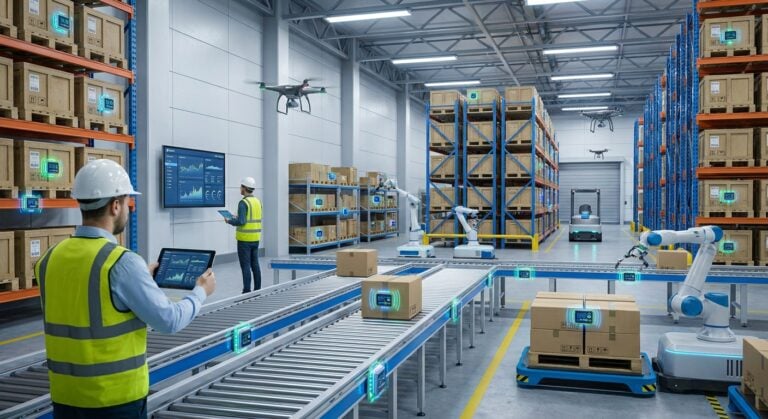
Why AI Training is a business priority for e-shops
AI Training is no longer a “nice to have” seminar for the marketing team. For an e-shop owner, it is a matter of speed, quality of execution and competitiveness. Artificial intelligence in e-commerce is already affecting content production, customer service, data analysis, merchandising, creation of advertising assets, email marketing and internal organization. The critical point is not whether the company will use generative AI tools, but whether its people will use them correctly, consistently, with quality control and with a clear connection to commercial goals such as conversion rate, average order value, repeat purchases and reduction of production time.
Social Media Examiner’s article on advanced AI training sets a very practical foundation: upgrading people comes before upgrading tools. Many companies buy subscriptions to AI platforms, but they don’t change processes, set standards, train teams in prompt engineering, and create mechanisms to evaluate results. As a result, AI remains fragmented: someone writes captions, someone else creates AI product descriptions without brand voice control, while customer support experiments with answers that may be fast but not always accurate. For an e-shop, this fragmentation translates into wasted time, inconsistent customer experience, and potential risk to the brand.
The pressure is not theoretical. According to the Microsoft and LinkedIn 2024 Work Trend Index, the use of AI in the workplace has gone mainstream, and leaders are now looking for people with AI skills. The chart below shows why AI Training should be viewed as an investment in human capital, not just technical training.
Quota
Employees bringing their own AI tools
78
Knowledge workers using AI
75
Leaders who prefer AI skills over experience
71
Leaders who wouldn't hire without AI skills
66
The key message of the approach presented in Social Media Examiner is that advanced AI training should focus on people, roles and workflows, not just tools. This is especially important for e-commerce teams, because their tasks are interconnected. A new product doesn’t just need a title and description. It needs SEO-friendly content, proper categorization, images or visual directions, email launches, social posts, ad copy, potential answers to customer questions and post-launch performance data. If each department uses AI differently, the result becomes uneven. But if there is a common methodology, the team can build repeatable production systems.
AI Training for an e-shop should start from real use cases: creating product descriptions, optimizing categories, generating FAQs, conducting competition research, creating email flows, analyzing reviews, customer support, advertising concepts, on-site search improvements, and segmentation. AI training becomes essential when the employee learns to transform a daily task into a clear process: inputs, prompts, checks, deliverables, and reuse. For example, a content manager doesn’t just need to ask “write me a product description.” They need to provide product data, target audience, USP, tone of voice, SEO keywords, claims restrictions, formatting instructions, and a review checklist before uploading the content to the CMS.
The difference between basic AI usage and mature AI workflow automation lies right here. Basic usage produces single outputs. Mature usage builds processes that are iterated, improved, and measured. An e-shop can create custom GPTs for specific functions, such as “Brand Voice Assistant,” “Product Description Reviewer,” “Customer Support Drafting Assistant,” or “Meta Ads Concept Generator.” But these custom GPTs are only valuable when they have been trained with proper brand guidelines, examples of good and bad answers, compliance rules, and clear boundaries for what they are allowed to suggest.
The need for a coordinated approach becomes even clearer when we look at the speed of adoption. McKinsey recorded that the regular use of generative AI in organizations increased from 33% in 2023 to 65% in 2024. As the graph below shows, the curve does not leave much room for companies that want to remain competitive.
Organizations that regularly use generative AI
The skills an e-commerce team needs
An effective AI Training program for e-shops should not be the same for everyone. The owner or e-commerce manager needs an AI strategy: how artificial intelligence connects to business goals, where to reduce costs, where to increase speed, what data is allowed to be used and what is the acceptable risk. The marketing team needs AI marketing automation, prompt frameworks, ad variant creation, content repurposing and performance analysis. The customer support team needs customer service automation, escalation rules, tone of voice and accuracy control. The product team needs processes for AI product descriptions, attribute enrichment, FAQs and on-site search improvement. Management needs AI governance, i.e. rules, responsibilities, approvals and measurements.
The core skills start with prompt engineering, but they don’t end there. A good prompt is just the beginning of a larger process. The team needs to know how to prepare context, how to ask for alternatives, how to check for hallucinations, how to compare outputs, how to protect sensitive data, and how to turn a successful prompt into a template. Especially for e-shops with hundreds or thousands of SKUs, consistency is more important than inspiration. If 20 products are written in a different style, different structure, and different level of information, the customer receives an inconsistent experience and SEO struggles to perform.
Employee upskilling also needs to take into account change management. People don’t always resist technology because they don’t want it. They often resist because they fear they will be evaluated negatively, that they will lose control of their work, or that AI will be used to increase pressure without better organization. To do this, a mature AI Training program explains what is changing, what is not changing, how quality is protected, and how the employee will gain time for more meaningful work. IBM has reported that 40% of its workforce will need to be reskilled within the next three years due to AI and automation, which shows that training is not a temporary action but an ongoing business function.
Percentage of workforce
Workforce that will need reskilling
40
Step-by-Step 90-day plan
A practical 90-day plan helps the e-shop move from experimentation to operational exploitation. In the first 15 days, an audit is carried out: which tasks are repeated frequently, how much time they consume, which tools the team already uses, what data is available and which points create bottlenecks. Here, 10 to 20 potential use cases are recorded and scored based on impact, ease of implementation and risk. Typically, the most immediately profitable use cases are producing AI product descriptions, improving email subject lines, creating FAQs from reviews, drafting answers for customer support and analyzing customer feedback.
From day 16 to day 30, the company creates the first standards. This means prompt templates, a brand voice guide, a list of prohibited claims, AI data privacy rules, and a checklist for checking before anything is published. For example, no AI-generated product text should be uploaded without checking technical features, claims, prices, availability, and compatibility with the return policy. Speed is only valuable if it doesn’t create errors that later cost in returns, bad experiences, or negative reviews.
From day 31 to day 60, the team is trained by role. Marketing works on campaign briefs, ad variations, landing page copy, and AI marketing automation. The content team works on SEO briefs, category descriptions, schema-friendly FAQs, and content repurposing. Customer support works on responses, escalation logic, and empathy guidelines. Management monitors dashboards with production time, number of deliverables, fix rate, and commercial results. At this stage, AI Training should be hands-on: people are trained on real products, real emails, and real tickets, not generic examples.
From day 61 to day 90, the e-shop selects the workflows that performed and transforms them into reusable systems. Custom GPTs or documented assistants are created, approvals are integrated, owners are assigned, and a monthly improvement cycle is defined. For each workflow, there must be a metric: production time per product, conversion rate on pages with a new description, email open rate, first response time to support, percentage of tickets that are resolved without a second contact, or reduction of errors in entries. Thus, AI training ceases to be a “lesson” and becomes a mechanism for improving operations.
Governance, quality and performance measurements
AI governance is what separates serious businesses from teams that are just testing new tools. In an e-shop, the use of AI touches customer data, commercial information, profit margins, return policies, legal claims and brand reputation. This requires clear policies: what data never goes into public AI tools, who approves content before it is published, which outputs need human review, when a ticket should be transferred to a human and how errors or improvements are recorded. AI does not eliminate responsibility. On the contrary, it makes responsibility more important, because content and decision-making become faster.
Metrics need to be practical, not flashy. It’s not enough to say that the team “uses AI.” We need to know if the time to create a campaign has been reduced from three days to one, if the CTR has improved, if product descriptions have fewer errors, if support responses are more consistent, and if the time to train new employees has been reduced. In e-commerce, the impact on the checkout journey is also particularly important. The Baymard Institute estimates the average cart abandonment rate at around 70%, which shows how great the value of any improvement in experience, product information, support, and trust messages is.
As the chart below shows, cart abandonment is not a minor leak but a major business problem. The right use of AI can help analyze abandonment reasons, create better abandoned cart emails, improve FAQs, personalize messages, and respond faster to pre-purchase questions.
Quota
Integrated shopping
29.8%
How to practically start an e-shop
The safest way to start an e-shop is to choose a small but measurable scope. For example, 50 products in a category with low-quality descriptions, an abandoned cart email flow, or a set of 100 customer support FAQs. The team applies AI Training on this scope, creates templates, compares before and after, and decides if the workflow is worth expanding. This approach reduces risk and gives management real data instead of impressions.
In practice, the first workshop can have four parts. First, task mapping: what we do today, who does it, how long it takes, and what are the common mistakes. Second, creating prompt templates: one for SEO descriptions, one for social posts, one for support responses, and one for emails. Third, quality review: the team learns to evaluate accuracy, style, clarity, marketability, and compliance. Fourth, operational rollout: each template gets an owner, instructions for use, and KPIs. In this way, AI Training is connected to daily execution, not abstract knowledge.
TWO DOTS approaches such projects with a commercial application in mind: which part of the e-shop will save time, which will increase quality, which will improve customer experience, and which can be automated without sacrificing the brand. The goal is not to replace human judgment, but to enhance it. The best e-commerce teams will be those that combine creativity, data, technology, and clear operating rules.
The conclusion is simple: AI Training should become part of every e-shop's business strategy. Not as an occasional seminar, but as a continuous system of upskilling, governance and workflow improvement. The sooner a company trains its people to think with AI, to control professionally and to measure results, the faster it will turn artificial intelligence from an experimental tool into a real competitive advantage.
Social Media Examiner – Upscaling Your People: Advanced AI Training
Microsoft and LinkedIn – 2024 Work Trend Index
McKinsey – The State of AI in 2023: Generative AI's Breakout Year
McKinsey – The State of AI in 2024
IBM Institute for Business Value – Augmented Work for an Automated, AI-Driven World
Baymard Institute – Cart Abandonment Rate Statistics
Frequently Asked Questions (FAQs)
Why is AI Training important for e-shops?;
AI Training is critical for e-shops as it improves speed, execution quality, and competitiveness. The correct use of artificial intelligence can positively impact content production, customer service, and other commercial processes.
What is the main challenge in using AI for e-commerce?;
The main challenge is the fragmented use of AI without a unified strategy, leading to inconsistency and wasted time. Training teams is more important than simply using AI tools.
How is AI connected to commercial goals in e-shops?;
AI can increase conversion rates, average order value, and repeat purchases, while reducing production time. The correct use of AI must be linked to clear commercial objectives.
What skills do e-commerce teams need for AI?;
Teams need skills like prompt engineering, data analysis, and quality management. Training should include AI strategy development, marketing automation, and customer support.
What are the first steps to integrating AI into an e-shop?;
Start by auditing existing processes and create standards such as prompt templates and brand voice guides. Train the team in specific roles and evaluate the results for continuous improvement.
How can AI reduce cart abandonment in e-shops?;
The right use of AI can analyze reasons for cart abandonment and create better abandoned cart emails. It can also improve FAQs and message personalization, thereby increasing purchase completion. What is the main challenge in using AI for e-commerce? The main challenge is the fragmented use of AI without a unified strategy, leading to inconsistency and wasted time. Training teams is more important than simply using AI tools. How does AI connect to commercial goals in an e-shop? AI can increase conversion rate, average order value and repeat purchases, while reducing production time. The right use of AI must be linked to clear commercial goals. What skills do e-commerce teams need for AI? Teams need skills such as prompt engineering, data analysis and quality management. Training should include AI strategy development, marketing automation and customer support. What are the first steps to integrating AI into an e-shop? Start with an audit of existing processes and create standards such as prompt templates and brand voice guides. Train the team in specific roles and evaluate the results for continuous improvement. How can AI reduce cart abandonment in an e-shop? The right use of AI can analyze reasons for cart abandonment and create better abandoned cart emails. It can also improve FAQs and message personalization, thus increasing purchase completion.