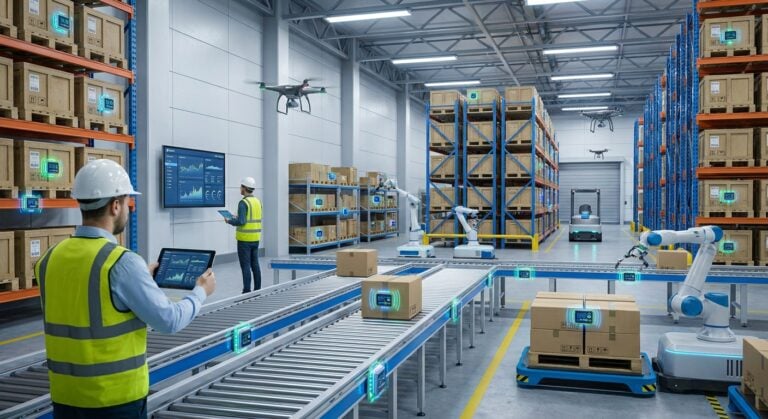
The conversation around AI often boils down to general promises: more speed, less cost, better decisions. DesignNews“ article on how AI and automation are changing NVH testing, or noise, vibration, and harshness testing in the automotive industry, provides a more practical lesson. In an environment where engineers are fewer, products more complex, and testing time more pressing, the value isn’t just in ”adding AI.” It’s in transforming a process filled with signals, noise, exceptions, and repetitive steps into a system that measures, learns, warns, and suggests actions.
The same is true for e-shop owners today. An online store does not test engines, suspensions or car cabins, but it does test the durability of the shopping experience every day: page speed, visitor behavior, cart abandonment, ad performance, inventory availability, customer experience, returns, reviews and support. If NVH testing tries to identify “noise” before it becomes a problem for the driver, a modern e-shop must identify commercial noise before it becomes a lost sale. This is where Artificial Intelligence can become a tool of operational discipline, not just an impressive add-on.
What NVH testing teaches e-shops about Artificial Intelligence
NVH testing relies on collecting signals from sensors, comparing them to acceptable limits, identifying anomalies, and quickly interpreting the results by specialized teams. According to DesignNews, the direction of the market is clear: AI and automation can speed up the process, reduce manual analysis, and allow fewer engineers to manage more and more complex tests. For an e-commerce owner, the corresponding model is the transition from “I look at reports when I have time” to “I have a system that constantly monitors the critical signals of the store.”.
In practice, the online store has its own “signals”: conversion rate, add-to-cart rate, checkout completion, average order value, cost per acquisition, repeat purchase rate, refund rate, support response time, product availability and engagement by channel. It also has its own “noise”: seasonality, algorithm changes in advertising platforms, out-of-stock products, poor feed quality, price inconsistencies, technical bugs, courier delays and customers abandoning because they cannot find what they want quickly. Artificial Intelligence works effectively when these signals are organized in a reliable data analytics environment and connected to decisions.
The point is not to replace human judgment. Just as an engineer still has the final say in interpreting a strange vibration, the owner or e-commerce manager must understand the business context behind the data. AI automation helps to quickly identify that something has changed, suggest possible causes, and automate repetitive actions, such as alerts, segmentation, inventory updates, ticket prioritization, or remarketing campaign activation. Value comes from the combination of human experience and machine consistency.
Why automation is becoming a priority in e-commerce
Business adoption of AI is no longer experimental. McKinsey reported that the percentage of organizations using AI in at least one business function increased from 50% in 2022 to 55% in 2023 and 72% in 2024. For e-commerce, this means that competition will not be limited to who has the best products or the most attractive design, but also to who can leverage data faster for pricing, personalization, inventory management, service and campaign performance. As the graph below shows, the adoption curve is accelerating and making inaction more expensive.
Organizations using AI in at least one function
For an e-shop owner, e-commerce automation doesn't start with complicated machine learning models. It starts with the everyday decisions that are currently made slowly or with incomplete insight. Which products should be promoted more? Which customers are likely to buy again? Which campaign is spending budget without a real contribution to profit? When is a product at risk of being out of stock? Which page is causing disproportionate exits? As long as these are answered manually, the business loses time and often reacts after the problem has already affected sales.
Another strong argument concerns checkout. The Baymard Institute estimates the average cart abandonment rate at 70.19%, a number that shows how much value is lost at the final stage of the purchase. Not every e-shop needs to solve everything with AI, but it does need to know precisely where friction is created. If the system detects that abandonment increases after a change in shipping, after a technical intervention or on a specific device, then the team can take immediate action. The graph below captures the scale of the problem.
Basket rate
Integrated shopping
29.81
The same logic applies to personalization. McKinsey has documented that 71% of consumers expect personalized interactions from businesses, while 76% are disappointed when this does not happen. For e-commerce, these percentages translate into a need for more relevant product recommendations, smarter email flows, better segmentation, and content that responds to user intent. Personalization is not a luxury for large businesses; it is a key element of operational efficiency, because it reduces waste on irrelevant messages and increases the likelihood of purchase.
Percentage of consumers
They get frustrated when there is no personalization
76
They expect personalized interactions
71
Step-by-Step guide to implementing AI automation in an e-shop
The first step is to define which business problems are worth automating. Don’t start with the tool, start with the cost of the problem. If the biggest leak is at checkout, the first use case should be cart recovery, funnel analysis, and alerts for sudden changes. If the problem is inventory, demand forecasting and connecting sales, suppliers, and seasonality are prioritized. If the problem is service, then conversational AI, ticket classification, and suggested responses can reduce response time without losing human quality.
The second step is data mapping. An e-shop typically has information in CMS, ERP, payment provider, Google Analytics, Meta Ads, Google Ads, email platform, CRM, helpdesk and logistics. Before any machine learning, you need to know what data exists, who maintains it, how reliable it is and what identifier it can be linked to. If products have different SKUs per system or if categories change without a rule, AI will produce fuzzy conclusions. In NVH testing, a bad sensor means a bad measurement; in e-commerce, bad tracking means a bad decision.
The third step is to create a “baseline” for your key metrics. Record at least 30 to 90 days of conversion rate, revenue, margin, returns, CAC, ROAS, repeat purchases, stockouts, lead time, and tickets per 100 orders. Without a baseline, you can’t tell if a change is a real problem or a normal variation. This is the business equivalent of a mechanic knowing which vibrations are normal for a vehicle and which indicate a failure.
The fourth step is to implement simple automations before moving on to more complex models. Set up alerts for a sharp drop in conversion rates, an increase in failed payments, increased load times, products with high traffic but low availability, and campaigns with a spend over a threshold without sales. These rules are not “smart” in the impressive sense, but they create the foundation on which more advanced AI will be built.
The fifth step is to introduce predictive analytics. Here you can predict demand per product, repurchase probability per customer, churn probability, out-of-stock risk, and future campaign performance. For example, a fashion store can combine historical sales, weather, seasonality, sizes, and returns for better inventory management. A cosmetics store can predict when a customer is running out of a product and send a personalized reminder before they switch to a competitor.
The sixth step is A/B testing with a clear hypothesis. Don’t test random button colors or headlines for no reason. Formulate a hypothesis, such as “showing shipping costs earlier will reduce checkout abandonment” or “personalized suggestions on the product page will increase add-to-cart rate.” Artificial Intelligence can help select segments, detect differences, and quickly interpret results, but the hypothesis must come from real customer understanding.
The seventh step is to connect automation with human oversight. Define who approves price changes, who reviews product recommendations, who monitors chatbot transcripts, and who has the right to disable an automation. AI should not function as a “black box” that makes commercial decisions without accountability. It should function as an experienced assistant that quickly does the heavy lifting and brings clear choices to the human.
The eighth step is to measure ROI. For each automation, define before implementation what you expect it to improve: fewer labor hours, higher conversion rate, lower service costs, fewer stockouts, higher average order value or better customer lifetime value. This way you avoid the trap of adopting technology because it is a trend and invest only where there is real business value.
Where attention is needed: data, trust and quality
Quality is where the lesson from NVH testing becomes particularly useful. In technical testing, automation only makes sense when signals are reliable and processes are repeatable. In e-commerce, the same goes for tracking, feeds, product labels, customer segments, and attribution models. If the ad system is recording the wrong conversions or if the ERP is not updating availability in a timely manner, then automation simply accelerates the error.
Furthermore, e-shop owners must approach AI with commercial realism. A chatbot may respond quickly, but if it gives incorrect information about returns, it damages trust. A dynamic pricing system may increase margins, but if it creates a sense of injustice among customers, it undermines the brand. A recommendation engine may increase sales, but if it suggests irrelevant products, it tires the user. Digital transformation is not simply installing tools; it is changing the way the business measures, decides and learns.
There is also the security dimension. E-shops manage personal data, transactions, behavioral patterns and commercially sensitive information. IBM reported in its Cost of a Data Breach 2024 report that the average cost of a data breach reached $4.88 million worldwide, while organizations that used extensive security AI and automation had an average of $2.22 million lower cost of breach compared to those that did not. Although the amounts concern international organizations and not necessarily small Greek e-shops, the message is clear: automation is not only about sales, but also about resilience.
Cost / savings
Average cost of breach
4.88
Cost reduction with extensive security AI and automation
2.22
From engineering tests to commercial learning systems
Frequently Asked Questions (FAQs)
The most practical conclusion from DesignNews’ approach is that automation works best when it’s embedded in a specific workflow. In NVH testing, AI doesn’t appear detached from the lab; it’s tied to measurements, repetitive processes, interpretation, and engineering decisions. In e-commerce, the corresponding maturity means that every critical brand must have an owner, threshold, alert, and pre-defined action. If conversion rates drop, who sees it? If ad costs go up, which campaign is reviewed first? If a product goes viral, how is inventory protected? If returns increase, who reviews descriptions, sizes, and photos?;
Artificial Intelligence becomes truly useful when it reduces the time from signal to decision. An e-shop that takes two weeks to understand that a product category has a pricing problem will lose sales. An e-shop that sees the discrepancy within hours can correct prices, change messaging, adjust advertising or contact suppliers. This is the difference between reporting and operational intelligence. For e-commerce owners, the right question is not “which AI tool should I buy?” The right question is “what repetitive decision am I making today that is slow, uncertain or costly?” That’s where automation should start. If the problem is support, start with ticket categorization and suggested responses. If it’s campaigns, start with alerts and clean attribution. If it’s inventory, start with demand forecasting. If it’s conversion, start with funnel diagnostics and A/B testing. Technology should serve the function, not complicate it. The future of e-commerce will belong to companies that build learning systems: they collect clean data, identify anomalies, test hypotheses, automate what is repeated, and keep humans where judgment, creativity, and responsibility are needed. Just as smart NVH testing allows fewer engineers to produce more reliable results, properly implemented AI can allow smaller e-commerce teams to operate with the discipline and speed of much larger organizations. DesignNews: AI and Automation Unlock Smarter NVH Testing with Fewer Engineers McKinsey: The State of AI Baymard Institute: Cart Abandonment Rate Statistics McKinsey: The Value of Getting Personalization Right IBM: Cost of a Data Breach Report 2024
How is Artificial Intelligence improving NVH testing in the automotive industry?;
Artificial Intelligence speeds up the NVH testing process, reduces the need for manual analysis, and allows fewer engineers to manage more complex tests. This leads to faster and more accurate anomaly identification.
What are the “signals” and “noise” in an e-shop and how does AI help?;
“Signals” include metrics like conversion rate and add-to-cart rate, while “noise” refers to seasonality and technical issues. Artificial Intelligence organizes this data, helping to identify and address problems early.
Why is automation important for e-commerce?;
Automation improves the performance of e-commerce stores with faster decision-making and better data management. This allows for effective customer experience management and increased sales.
What are the basic steps for implementing AI automation in an e-shop?;
Start by identifying business problems that deserve automation. Map your data, create baseline metrics, and introduce simple automations before moving on to more complex models.
How does personalization affect e-commerce?;
Personalization increases sales and improves customer experience through relevant product recommendations and personalized email flows. It is critical for increasing customer satisfaction and loyalty.
What are the risks of using AI in e-commerce?;
Risks include data unreliability, faulty decision automation, and the potential for data breaches. Proper governance and oversight are essential to avoid these issues. FAQs The most practical takeaway from DesignNews“ approach is that automation works best when it’s embedded in a specific workflow. In NVH testing, AI doesn’t appear detached from the lab; it’s tied to measurements, repetitive processes, interpretation, and engineering decisions. In e-commerce, the corresponding maturity means that every critical brand must have an owner, threshold, alert, and pre-defined action. If conversion rates drop, who sees it? If ad costs go up, which campaign is reviewed first? If a product goes viral, how is inventory protected? If returns increase, who reviews descriptions, sizes, and photos? AI becomes truly useful when it reduces the time from signal to decision. An e-shop that takes two weeks to understand that a product category has a pricing problem will lose sales. An e-shop that sees the discrepancy within a few hours can correct prices, change messaging, adjust advertising or contact suppliers. This is the difference between reporting and operational intelligence. For e-commerce owners, the right question is not ”which AI tool should I buy?“ The right question is ”what repetitive decision am I making today that is slow, uncertain or costly?“ That’s where automation should start. If the problem is support, start with ticket categorization and suggested responses. If it’s campaigns, start with alerts and clean attribution. If it’s inventory, start with demand forecasting. If it’s conversion, start with funnel diagnostics and A/B testing. Technology should serve the function, not complicate it. The future of e-commerce will belong to companies that build learning systems: they collect clean data, identify anomalies, test hypotheses, automate what is repeated, and keep humans where judgment, creativity, and accountability are needed. Just as smart NVH testing allows fewer engineers to produce more reliable results, properly implemented AI can allow smaller e-commerce teams to operate with the discipline and speed of much larger organizations. DesignNews: AI and Automation Unlock Smarter NVH Testing with Fewer Engineers McKinsey: The State of AI Baymard Institute: Cart Abandonment Rate Statistics McKinsey: The Value of Getting Personalization Right IBM: Cost of a Data Breach Report 2024 How is AI improving NVH testing in the automotive industry? AI speeds up the NVH testing process, reduces the need for manual analysis, and allows fewer engineers to manage more complex tests. This leads to faster and more accurate identification of anomalies. What are ”signals“ and ”noise“ in an e-shop and how does AI help? ”Signals“ include indicators such as conversion rate and add-to-cart rate, while ”noise“ concerns seasonality and technical issues. Artificial Intelligence organizes this data, helping to identify and address problems early. Why is automation important for e-commerce? Automation improves the performance of e-commerce stores with faster decision-making and better data management. This allows for effective management of the customer experience and increased sales. What are the key steps for implementing AI automation in an e-shop? Start by identifying business problems that deserve automation. Map your data, create ”baseline” indicators and introduce simple automations before moving on to more complex models. How does personalization impact e-commerce?Personalization increases sales and improves customer experience through relevant product recommendations and personalized email flows. It is critical for increasing customer satisfaction and loyalty. What are the risks of using AI in e-commerce?Risks include data unreliability, incorrect decision automation, and the possibility of data breaches. Proper management and oversight are essential to avoid these problems.