From factory to e-commerce: why robotics is entering a new phase
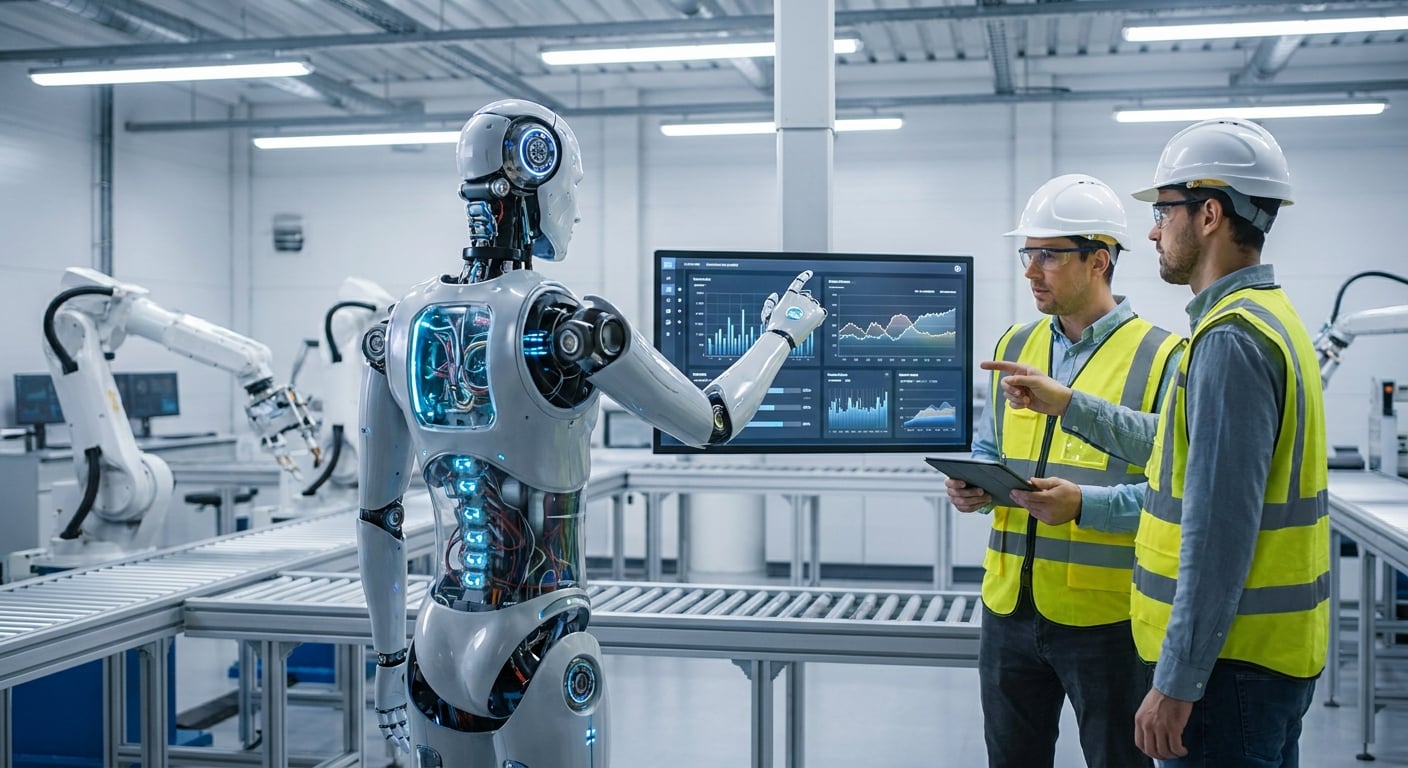
The DesignNews article on humanoid robots describes a change that businesses can no longer treat as a distant scenario: robotics is no longer solely a matter of industrial arms behind guardrails and is beginning to be linked to artificial intelligence systems, sensors, computer vision and automation that can operate in environments designed for humans. Humanoid robots are of interest not just because they look like humans. The essential point is that they can, in theory, move around in warehouses, picking areas, distribution centers, stores and production lines without requiring a complete reconstruction of physical space.
For an e-commerce owner, this point is crucial. The pressure for faster delivery, lower operational costs, fewer fulfillment errors and greater supply chain resilience is not diminishing. Instead, as consumers get used to next-day or even same-day delivery, the internal operations of an e-store become as important as performance marketing, SEO or conversion rate optimization. Robotics, especially when combined with AI automation, transforms from a technological innovation to a tool for business competitiveness.
The debate around humanoid robots has often been exaggerated. There is enthusiasm, but there are real obstacles: cost, battery autonomy, safety, reliability, regulatory compliance and integration with existing ERP, WMS, OMS and e-commerce platforms. Nevertheless, the direction is clear. Robotics is becoming more agile, artificial intelligence is improving machine perception and decision-making, and the need for logistics automation is creating commercial incentives that are accelerating adoption.
What changes when artificial intelligence meets humanoid robots
Classical industrial robotics has for decades been based on highly precise, repetitive movements. A robot on a car production line knows exactly where the object is, which movement it has to make and in what time frame. In e-commerce, however, the environment is more chaotic. A product may have a different size, material, weight, packaging or shelf position. This is where the role of machine learning, computer vision and autonomous robots that can recognize objects, perceive obstacles and adjust their behavior comes in.
Humanoid robots, or humanoid robots, have a design advantage because they can make use of infrastructure built for humans: stairs, doors, shelves, workbenches, handles, tools and corridors. This doesn't mean they will directly replace specialized AMRs, conveyor systems or cobots. But it does mean that it opens up a new category of automation for tasks that have been difficult to do to date because they required flexibility, physical movement and real-time judgment.
For example, a fulfillment center may today use warehouse automation to transfer baskets, barcode scanners for stock confirmation and robotic process automation for automatic order updates. The next level is to connect all of these with physical robots that can take on more complex micro-tasks: moving products, supporting picking, replenishing packing stations, detecting shelf shortages and working with human teams. There, robotics does not operate as an isolated machine, but as part of a larger functional ecosystem.
Data shows that automation is no longer a regional investment
According to the International Federation of Robotics, annual installations of industrial robots worldwide remain at an all-time high, with 541,000 installations in 2023, following a record 553,000 in 2022. This matters for e-commerce because the maturing industrial automation market is gradually reducing technology costs, increasing the availability of skilled integrators and creating more reliable safety standards. As shown in the chart below, the trajectory of installations from 2019 to 2023 indicates that robotics has moved from the experimental adoption phase to the mass business use phase.
Global annual industrial robot installations
Source: International Federation of Robotics, World Robotics 2024, rounded figures
The geographical distribution also shows where know-how is developing fastest. Asia accounts for about 70% of new industrial robot installations, Europe for about 17% and the Americas for about 10%, according to IFR. This is not just an industrial statistic. For European and Greek e-commerce businesses, it means that supply chains, equipment manufacturers and international 3PL players will be affected by markets where automation is rapidly evolving. As illustrated in the next graph, the global market is not moving uniformly, so the choice of partners and technologies must be done with care.
Distribution of new robot installations by region in 2023
Source: International Federation of Robotics, World Robotics 2024
Asia70%
Europe17%
America10%
Other areas3%
The most striking indication of where the market is heading comes from the forecasts for humanoid robots. Goldman Sachs has revised its estimate for the global humanoid robot market to 2035 from $6 billion to $38 billion, more than six times higher than the previous forecast. This revision does not guarantee that every business will immediately need humanoid robots, but it does show that investors, manufacturers and major technology players see a commercial field much larger than what was seen a few years ago.
Humanoid robot market forecast to 2035
Source: Goldman Sachs Research, 2024
Previous forecast 203514%
Practical applications for e-commerce, logistics and operations
The key question for a professional is not whether humanoid robots are impressive, but where they can really improve P&L. In e-commerce, the most immediate applications are in warehousing, inventory management, packaging, product returns and linking physical tasks with digital flows. Supply chain automation is not just about moving boxes. It's about accurate inventory visibility, reducing errors, prioritizing orders faster, optimizing space and better utilizing human resources in higher value tasks.
In picking, for example, robotics can help either with mobile robots that bring products to the worker or, in the future, with humanoid robots that will move along existing aisles and perform actions closer to the human way of working. In packaging, AI automation systems can select appropriate packaging based on dimensions, weight and product sensitivity, reducing materials and transportation costs. In returns, where many businesses are losing margin, automation can sort, photograph, inspect and direct products for resale, repair or recycling.
There is also significant scope in last-mile delivery robots, although here the challenges are greater due to urban infrastructure, regulations and public acceptance. For brands with physical stores, dark stores or micro-fulfillment hubs, autonomous robots can act as a complement, not a complete replacement for human labor. The most realistic approach for the coming years is a combination of humans, cobots, software and data-driven processes.
This is the critical business conclusion: robotics should not be treated as a machine purchase, but as a process redesign. If a warehouse has fuzzy inventory data, poor location labeling, non-standard packaging and low quality product data, adding robots will not solve the problem. Instead, it will make it more expensive. Before making any investment, the business needs to clean data, measure times, map bottlenecks and link automation to specific KPIs.
Step-by-Step guide to evaluating an investment in robotics
Proper adoption starts with small, measurable steps. The first step is process mapping. Capture the path of an order from the moment it enters the system to the moment it is delivered to the courier. Measure picking time, packing time, waiting time, errors, returns, cost per order and man hours per stage. Without this data, any talk of warehouse automation or humanoid robots is more of an impression than a strategy.
The second step is to choose a use case. Don't start with the most spectacular scenario, but with the most repeatable and measurable one. For a mid-sized e-commerce business, this could be automated cart transfer, returns management, inventory control with computer vision or automating updates through robotic process automation. For larger businesses, it could be connecting WMS with mobile robots, predicting demand with machine learning or piloting cobots at packing stations.
The third step is the ROI calculation with realistic assumptions. Calculate initial equipment costs, integration costs, maintenance, team training, potential downtime during installation, and security costs. On the flip side, measure time savings, reduced errors, increased throughput, less need for seasonal hiring, better inventory accuracy and the ability to expand without a commensurate increase in space or staffing. A robotics project that is not tied to an economic model risks becoming an expensive proof of concept.
The fourth step is the technical interface. Check if the e-commerce platform, ERP, WMS, OMS and courier integrations can exchange data in real time. Robotics needs pure events: new order, priority change, stock update, cancellation, return, replenishment. If systems work with manual exports and spreadsheets, digital integration takes precedence.
The fifth step is an 8 to 12-week pilot programme with a clear scope. Define a warehouse zone, a product category or a specific stage of the process. Measure before and after. Don't just evaluate speed. Check accuracy, safety, team acceptance, downtime, ease of maintenance and quality reporting. The sixth step is scaling, but only if the pilot passes predefined criteria. Maturity is not measured by how many robots a company buys, but by how consistently it can integrate them into its daily operations.
Risks, limits and the strategic position of businesses
Despite progress, humanoid robots are not yet a universal solution. Autonomy, limb dexterity, real-world durability, repair costs, and safety around humans remain critical issues. Also, the more artificial intelligence is integrated into physical systems, the more important data governance becomes. Who has access to operational data? How are images from cameras stored? How is a decision of an autonomous system documented? How is the business protected from downtime or cyber risk?;
There is also a human dimension. Automation fails when it is presented as a threat instead of a tool. Warehouse and operations teams know better than anyone the practical obstacles of a process. If they get involved from the start, they can help to plan properly, identify risks and improve system performance. If ignored, even the best technology will meet resistance.
For e-commerce businesses, the smartest attitude today is neither uncritical adoption nor waiting. It is preparation. That means clean product data, proper systems architecture, measurable operations, partners with expertise and a culture of continuous improvement. Robotics will become more affordable, AI models will become more capable and logistics automation solutions will mature. Those who have already organized their processes will be able to seize the opportunity faster and with less risk.
The future described in DesignNews is not just about walking machines. It's about the convergence of the physical and digital worlds: smart factories, warehouses with real-time intelligence, autonomous robots that collaborate with humans, and systems that learn from the data of daily operations. For a brand that wants to grow, the question is not whether robotics will influence e-commerce. The question is which part of the value chain will be automated first and whether the business will be ready when it becomes economically advantageous.
DesignNews: Humanoid Robots Open to a Future Where AI and Automation Merge
International Federation of Robotics: World Robotics 2024
Goldman Sachs Research: The global market for humanoid robots could reach $38 billion by 2035
McKinsey Global Institute: Generative AI and the future of work in America
Stanford AI Index Report
n.n.
Frequently Asked Questions
How does robotics affect e-commerce?;
Robotics improves delivery speed, reduces operational costs and increases the resilience of the supply chain. Its integration with AI automation enhances operational competitiveness.
What are the main barriers to the adoption of humanoid robots?;
The main barriers include cost, battery autonomy, safety and integration with existing systems. Reliability and regulatory compliance are also important issues.
What practical applications do robots have in e-commerce?;
Robots can help with inventory management, packaging, product returns and linking physical tasks with digital flows. Especially in picking and packing, they improve efficiency and reduce errors.
Why is artificial intelligence important in robotics?;
Artificial intelligence allows robots to recognise objects, perceive obstacles and adapt their behaviour. It improves perception and real-time decision-making.
What is the importance of the geographical distribution of robot installations?;
Asia accounts for 70% of new installations, affecting supply chains and equipment markets. For European e-commerce businesses, this means they need to choose partners and technologies carefully.
How can a business prepare for robotics adoption?;
Preparation includes process mapping, data cleansing and KPI measurement. Working with experts and piloting robots on small scales can reduce risk.
What is the business case for robotics integration?;
Robotics should be seen as a process redesign and not just as a purchase of machinery. Success lies in organising processes and linking automation to specific economic models.