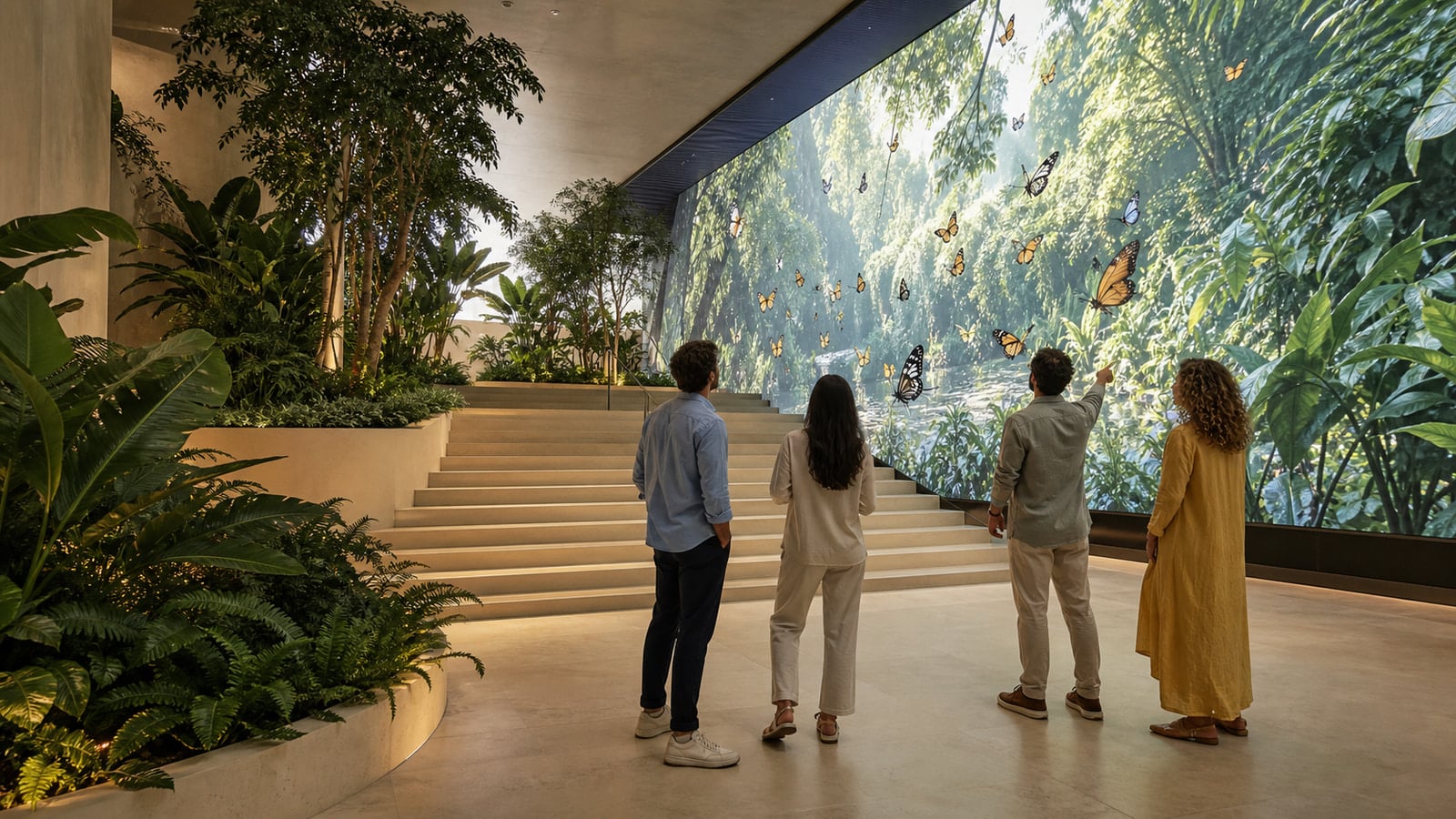
The immersive retail experience of The Butterfly Trail demonstrates that technology takes on commercial significance when space, local history, and measurement are designed as a single system. In Bangkok, Pixel Artworks didn’t simply replicate a successful installation from London: it integrated digital storytelling with Happitat’s natural garden, the architecture of the Grand Stairs, and an interactive experience that begins on a smartphone without the need for a special app.
For professionals in marketing, retail, and customer experience, the value of this case study lies not only in the big picture. It lies in how a creative IP retains its recognizable core while adapting what’s necessary to achieve local relevance. This is the key lesson: an immersive concept isn’t scaled by copying files, but by redesigning the relationship between the audience, the location, the interaction, and the data.
Scope of the case: The published data describe engagement with The Butterfly Trail and do not constitute an independently verified benchmark for the entire immersive retail sector. There is no publicly available data on costs, sales, conversion rates, or dwell time for the Bangkok location, so a commercial ROI cannot be substantiated.
From Outernet London to its Asian debut
"The Butterfly Trail" was first presented at Outernet London in September 2023 as Pixel Artworks' first Originals project. The Outernet’s official page describes a free mixed-reality experience at the Now Building, where visitors use their smartphones to release digital butterflies and trigger real-time animations. The concept subsequently traveled to locations in the United Kingdom and Greece.
The installation at Happitat Bangkok marks the project’s debut in Asia. According to Design Week, it is located on the largest indoor digital screen in Southeast Asia and operates under an 18-month license, free of charge to the public. This duration sets it apart from a short-term promotional activation: it is a planned asset for the destination, though this does not mean that corresponding commercial results have been published.
From a business perspective, this journey demonstrates how an experiential concept can be treated as reusable IP. Reuse, however, is not mechanical. Each new location changes the flow of visitors, the architecture, the cultural points of reference, and the points where the experience must connect with the brand’s promise. The same principle applies in cases where the Branding transforms a cultural heritage site into a cohesive experience.
Space as part of the interface
Happitat is a 200,000-square-meter lifestyle and retail complex operated by Axtra Happitat Co., Ltd. The installation is located at the Grand Stairs and transports visitors to the botanical laboratory and greenhouse of the fictional explorer Professor Peter Pelgrin. The stairs, the large screen, the movement of the audience, and the natural garden do not function as separate sets; they collectively form the path of the experience.
This changes the way the brief needs to be written. The question isn’t just what will be displayed on the screen, but from which direction the visitor is approaching, what they see before interacting, where they stand, how they understand the next step, and what those who aren’t actively participating notice. The the relationship between behavior and the environment It is crucial because an incorrect placement can undermine even the strongest creative.
Three levels that come together as a single experience
App-less interaction reduces friction
Visitors use their smartphones to transform digital chrysalises into CGI butterflies that land on their palms. No bespoke app or special hardware is required. For a public experience with a passing audience, this approach eliminates three potential barriers: installing an app, creating an account, and learning how to use an unfamiliar device.
«No app» does not mean «no UX.» The visitor still needs a clear entry point into the flow, immediate feedback, a perceptible connection between action and result, an accessible alternative for those who cannot or do not want to use a camera, and an easy way out. The same Principles of Clear UX and Next Steps They still apply even when the interface extends into a physical space.
In its Bangkok edition, Design Week reports that the augmented reality features were developed using Vamplify and leverage the Snap Camera Kit. Snap’s official documentation describes the Camera Kit as an SDK for integrating AR experiences into iOS, Android, and web applications. This describes the category of the technology, not the exact implementation architecture of Happitat.
Technical distinction: The official Pixel Artworks page for the original London release mentions an interface between Unreal Engine and 8th Wall in collaboration with Aircards. The source for Bangkok mentions Vamplify and Snap Camera Kit. The two descriptions refer to different implementations and should not be conflated into a single, supposedly unchanging stack.
Localization has become part of the story world
For Bangkok, the digital butterflies were redesigned to represent species found in Happitat’s natural butterfly garden, including the lime swallowtail and the plain tiger. This selection creates a thematic bridge between the living nature of the space and the indoor digital displays.
The essence of localization here is not simply a translation or a change in the color palette. The new material influences the concept, the interaction, and the story world. The visitor doesn’t see a generic «tropical» setting, but a version that strives to belong to Happitat. This connection between place and identity is more enduring than a superficial “re-skin,” as evidenced by the need to convey a brand from the region, woven into its own cohesive narrative.
Concept copying or substantive localization?
Pixel Artworks preserves the world of Professor Peter Pelgrin, the botanical laboratory, the butterflies, and the sense of discovery. These are the recognizable elements of the IP. In contrast, local species, architectural design, and technical execution may vary. This balance allows for the reuse of creative assets without turning every new installation into a rigid replica.
For a brand portfolio, the model requires a clear distinction between invariants and variables. Invariants are the core promise, the tone, the rules of the world, and the recognizable involvement. Variables are the elements that must be adapted to the audience, culture, physical space, devices, and operational constraints. This avoids discrepancies in the overall brand experience without sacrificing local relevance.
This separation also aids in production. Reusable assets, interaction rules, and measurement logic can be versioned and tested centrally, while local variations undergo their own content review, accessibility check, and technical QA. In this way, the IP scales as a system rather than as a folder containing display files.
What Do Engagement Figures Really Measure?
For its first year of operation, Pixel Artworks and Design Week report more than 1.36 million digital butterfly releases, 3.94 million nectar vial collections, and 378,000 active sessions. They also report over 28 million combined views on Instagram and TikTok. These numbers are useful as different indicators of engagement, but they should not be added together or converted into an arbitrary «success metric.».
Four published trademarks from the first year
Metrics of various types from Pixel Artworks and Design Week; these do not constitute a single funnel, an independent benchmark, or proof of ROI.
1.36 million.digital butterfliesliberating actions within experience
3.94 million.nectar vialsindividual collections on Interaction
378.000active sessionsa separate usage level from events
28 million+social viewsCombined Instagram and TikTok views
Proper interpretation starts with the denominators. Releases and nectar vials are events; active sessions are visits to the interaction; and social views are distribution metrics outside the platform. A marketing team needs to define what it considers a unique participant, which events can be repeated within the same session, and whether social views come from owned, earned, or paid distribution.
Decision Point
Don't approve an immersive retail investment based on a high reach figure. Link each metric to its corresponding goal: engagement in the space, initiation and completion of interactions, quality of participation, consent to data collection, shareable output, and—only where performance is adequate—visits, leads, or sales.
From participating in the shareable moment
The digital butterfly that lands on the palm creates a simple, recognizable moment. The user can understand what happened and capture it without having to explain a complex game. In this way, the interaction generates content that can be shared on social media and extend the experience beyond the physical space.
Shareability shouldn’t be designed solely as a «photogenic setting.» It requires a clear climax to the interaction, adequate lighting, time to take the photo, ease of understanding for the viewer, and the user’s choice as to whether to save or share the result. A Instagram Strategy for Businesses It has value when the material is part of a genuine content system and isn't based solely on the hope of going viral.
The 28 million views show that this particular experience generated significant public attention—not that every visually striking installation will do the same. When designing a campaign, the team must map out the path from physical interaction to content, channel, audience, and the next step. This is where experiential design and Media planning with clear objectives and metrics.
What does this mean for retail and destination brands?
For a retail destination, a free experience can serve as a reason to visit, a point of differentiation, and a catalyst for repeat visits. Happitat describes the destination itself as a synthesis of nature, people, imagination, and technology-enhanced interaction. The Butterfly Trail fits this promise because it does not stand as an isolated media object; it is connected to the garden and the spatial identity of the complex.
Nevertheless, the operator should not assume that engagement equates to commercial value. A measurement plan is needed that distinguishes between audience volume, interaction quality, operational costs, repeat visits, traffic to specific zones, and downstream actions. The Analytics platforms are valuable when the data leads to specific decisions, not when they simply collect more counters.
The experience must also be integrated into the rest of the customer journey. What do they see before they arrive? What do they understand while they’re there? What kind of relationship can they maintain afterward, without being forced to create an account or download an app? The answer requires a deeper understanding the customer in terms of behavior and motivations, not just demographic targeting.
Seven Steps to a Measurable Immersive Retail Experience
The case of The Butterfly Trail is not a one-size-fits-all solution. However, it offers enough specific elements to develop a practical brief: a narrative core, a local connection, architectural path, low friction, a clear moment of engagement, separate metrics, and functional governance.
From Concept to Controlled Retail Activation
- Step 1Define the behavior you want to create
Determine whether the goal is engagement, retention, participation, user-generated content, or downstream action before selecting a display, AR stack, or producer.
- Step 2Separate the fixed core from the local variables
Identify which elements of the IP remain unchanged and which need to be adapted to the type of venue, cultural aspects, language, architecture, and visitor flow.
- Step 3Map the space as an interface
Test approach points, visibility, lines, safe stopping, accessibility, the surrounding crowd, and the transition from observation to active use.
- Step 4Reduce friction without hiding the terms
Limit downloads and registrations, but ensure clear notifications, consent, permissions, an alternative path, and immediate feedback for every interaction.
- Step 5Design a clean, shareable highlight
Provide the user with a visually intuitive moment—with timing, lighting, and framing—that allows for optional recording without interrupting the experience of others.
- Step 6Here are the event taxonomy and common names
Distinguish between unique participants, sessions, starts, completions, repeat events, shares, and downstream outcomes so that teams do not compare dissimilar metrics.
- Step 7Treat activation as a product
Plan for content updates, technical monitoring, moderation, accessibility reviews, incident response, privacy checks, and improvement cycles throughout the duration of the license.
Metrics, Privacy, and Limits
The public dataset does not provide production costs, revenue, conversion data, demographic analysis, or a complete methodology for calculating social views. It therefore does not allow for an ROI comparison with other platforms. A well-documented evaluation requires at least a baseline prior to activation, a clear attribution window, operating costs, and an agreed-upon downstream outcome.
The use of camera-based AR also requires a specific privacy review. The Snap Camera Kit terms require users to be informed of the terms and privacy policy before granting access, while the application documentation notes that the host application is responsible for camera, microphone, and, where necessary, location permissions. This does not specify which settings Happitat uses; however, it defines what must be checked in every new implementation.
In practice, the analytics plan must implement data minimization, a short retention period, informed consent where required, and the separation of aggregated performance metrics from personal data. The team must know who is collecting what, for what purpose, and who responds to user requests. Measurement isn’t just a footnote to the creative—it’s part of the trust the brand seeks to build.
The Key Lesson of *The Butterfly Trail*
The case of Bangkok shows that immersive design comes together when technology fosters a connection between the visitor and the place. The large screen provides a sense of scale, the smartphone offers personal interaction, the local butterfly species provide context, and the natural garden serves as a real-world point of reference.
For marketers and business owners, the right starting point isn’t «What technology should we buy?», but «What behavior and what connection do we want to create?». The choice of channel, content, and analytics must follow this answer. The same applies to every an effort to link user experience and performance: First, the actual change in the customer journey is defined, and then the metric that can demonstrate it.
"The Butterfly Trail" does not prove that every mixed-reality installation boosts sales. However, it does demonstrate—with careful execution—that a creative IP can thrive when designed to evolve alongside its setting, remain user-friendly, and be measured without conflating engagement with business results.
Digital Marketing & SEO
Link the brand experience to a measurable customer journey
TWO DOTS organizes content, landing pages, analytics, social media campaigns, and conversion points so that a retail activation maintains continuity before, during, and after the visit.
Frequently Asked Questions (FAQs)
What is The Butterfly Trail?
It is a mixed-reality experience by Pixel Artworks featuring digital butterflies, a large LED display, and smartphone interaction. It was first presented at Outernet London in September 2023.
Where is the Bangkok edition located?
It is located on the Grand Stairs at Happitat Bangkok, a 200,000-square-meter lifestyle and retail complex operated by Axtra Happitat Co., Ltd.
Is a special app or equipment required?
No. Visitors use their smartphones without a custom app or special hardware, according to the published description of the installation.
How did it adapt to the local environment?
The digital butterflies were redesigned to represent species found in Happitat's natural garden, such as the lime swallowtail and the plain tiger.
What AR technology is being discussed for Bangkok?
Design Week reports on development using Vamplify and the Snap Camera Kit. The original London edition is described separately, featuring Unreal Engine, 8th Wall, and Aircards.
What engagement figures have been published?
For the first year, the figures include over 1.36 million butterfly releases, 3.94 million nectar vials, 378,000 active sessions, and 28 million combined views on Instagram and TikTok.
It's free—how long will it be available?
The Happitat experience is free to the public and is reportedly set to operate under an 18-month license.
Does the data demonstrate a commercial ROI?
No. No data on costs, revenue, conversion rates, or dwell time has been published for Bangkok; therefore, the engagement figures are not sufficient for a well-founded ROI calculation.