AI data centres: why carbon emissions have become a business risk
The debate around AI is no longer limited to productivity, automation or the quality of a model's answers. The question that is increasingly emerging, as DesignNews points out in its article on whether carbon emissions can limit AI data centers, is a much more practical one: is there enough electricity, grid, cooling, physical infrastructure and social acceptance to continue the exponential growth of AI without severe limitations? For an e-commerce owner, this is not a distant technical issue that only concerns hyperscalers. Every online store that uses cloud computing, recommendation engines, AI search, personalization, generative content, chatbots, marketing automation or advanced analytics relies on infrastructure that consumes energy and creates a direct or indirect carbon footprint. See also: Digital Marketing & SEO, business automation & AI, website construction, e-shop construction.
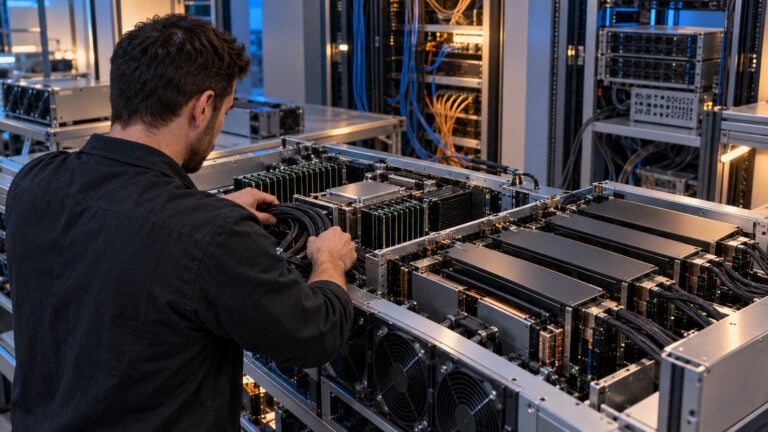
AI is creating a new level of demand on top of the already growing digital economy. AI data centers are not just larger versions of traditional data centers. They accommodate denser racks, specialized accelerators such as GPUs, increased needs for cooling systems, and much more demanding loads when training and running models. This turns carbon emissions from a corporate responsibility issue to a cost factor, service availability and vendor selection strategy. If energy becomes a bottleneck, businesses relying on AI services may see higher cloud costs, delays in new operations, tighter usage policies or more pressure from customers and investors for an informed ESG strategy.
The bottom line for e-commerce is that digital growth can no longer be evaluated only in terms of conversion rate, ROAS and speed of implementation. Another criterion needs to be added: how efficiently computing power is used. Sustainable AI does not mean that businesses should stop using AI. It means choosing the right workloads, measuring the value of any automation, avoiding overuse of models where they are not needed, and partnering with providers that invest in renewable energy, energy efficiency and transparent emissions reporting.
The real numbers behind the energy consumption of data centres
The available data show why the issue has been passed from the technical teams to the boards. According to the International Energy Agency, electricity consumption from data centres, AI and cryptocurrencies was around 460 TWh in 2022 and could reach up to 1,050 TWh in 2026. To get an idea of the magnitude, the IEA compares this level to the electricity consumption of a large industrialized country. This is not a small environmental footnote, but a scale that can affect energy markets, grid investments and local licenses to install new data centers. As shown in the graph below, the range of the projection is wide, but even the low scenario shows a significant increase in just four years.
Global electricity consumption by data centres, AI and crypto
Source: International Energy Agency, Electricity 2024
2026 high scenario
1050TWh
The picture is even more concrete in the United States, where the growth of AI clusters and cloud regions is accelerating demand. The Lawrence Berkeley National Laboratory's report on U.S. data center energy usage states that data centers consumed about 176 TWh in 2023, an amount that accounted for 4.4% of total U.S. electricity consumption. For 2028, the forecast ranges from 325 to 580 TWh, a potential increase that could change the priorities of utilities, local authorities and companies buying cloud capacity. For e-commerce businesses operating internationally, the US market is an important signal: when pressure increases in one of the more mature cloud markets, costs and constraints can gradually shift to managed services, SaaS tools and platforms used by the market.
Electricity consumption of data centers in the US
Source: Lawrence Berkeley National Laboratory, 2024 United States Data Center Energy Usage Report
2028 high scenario
580TWh
The same report shows that the share of data centers in US electricity consumption may increase from 4.4% in 2023 to 6.7% to 12% in 2028. This shift is critical for those who see green data centers as a mere branding option. In practice, when an infrastructure category absorbs a double-digit percentage of electrical demand, decisions about location, energy contract, cooling systems and load management become strategic. The chart below illustrates the potential growth in data centers' share of total U.S. electricity consumption.
Share of data centers in US electricity consumption
Source: Lawrence Berkeley National Laboratory, 2024 United States Data Center Energy Usage Report
Carbon emissions do not only result from electricity consumed in real time. There are also Scope 3 emissions: manufacturing of servers, chips, buildings, cooling systems, supply chain and replacement of equipment with short life cycles. This explains why even large tech companies, with significant renewable energy markets, are seeing an increase in their total reported emissions. Google reported in its Environmental Report 2024 that its total emissions in 2023 were 48% higher than in 2019. Microsoft reported that its emissions in FY2023 were 29.1% higher than its 2020 baseline, primarily due to data center growth and embedded carbon emissions in materials and hardware. As shown in the graph below, the scaling of AI infrastructure is putting pressure on even organizations with mature sustainability policies.
Increase in reported emissions in large technology companies
Sources:Google Environmental Report 2024, Microsoft Environmental Sustainability Report 2024
Google: 2023 vs. 2019
48%
Microsoft: FY2023 versus 2020 baseline
29.1%
What this means for e-commerce owners and digital teams
For an e-commerce owner, it's not a matter of figuring out the consumption of a GPU cluster on their own. The critical thing is to understand where AI adds real business value and where it is used simply because it is available. An AI chatbot that substantially reduces support tickets, a semantic search that increases conversion on large product catalogs or a demand forecasting system that reduces stockouts and returns can justify their computational consumption. Conversely, mass producing content without a strategy, over-generating images for small variations or using large models for simple classifications can increase costs and carbon footprint without corresponding value.
There is a second level of risk: reliance on third-party providers. Most e-commerce brands use SaaS platforms, CDNs, ERP connectors, marketing automation suites, cloud hosting, analytics and AI tools without direct visibility into their energy behaviour. When AI carbon emissions become subject to regulatory and commercial pressure, large companies will increasingly request data from their supply chain. This is particularly relevant for B2B e-commerce, marketplaces and brands that partner with multinationals or participate in tenders. The question “what is your digital carbon footprint?” can become as common as asking about GDPR, uptime and cybersecurity.
At the same time, the energy consumption of data centres can affect the pricing of services. If hyperscalers pay more for electricity, interconnects, cooling systems, new power units or carbon-free power purchase agreements, some of these costs may be passed on to customers. This does not necessarily mean that the cloud will become unaffordable. But it does mean that businesses need to acquire FinOps and GreenOps discipline: metering workloads, shutting down unused resources, avoiding overprovisioning, choosing appropriate hosting locations, and using caching, edge computing and more efficient architecture where it makes sense.
Step-by-Step: How to reduce the carbon footprint of your digital stack
The transition to more responsible use of AI need not start with complex metrics. It can start with a practical audit that links cost, performance and environmental impact. The first step is to map all the AI and cloud functions that e-commerce uses: hosting, search, recommendation engine, product feed optimization, email personalization, email personalization, ad creative generation, customer support automation, analytics, fraud detection and logistics systems. For each function, record who the provider is, what the business outcome is, how often it is performed, what the monthly cost is, and if data is available for emissions, renewable energy or region-level carbon intensity.
Second step is to classify workloads by value. Divide them into three categories: high-value, supporting and questionable value. High-value workloads are those that increase revenue, reduce costs or significantly improve the customer experience. Supportive are those that help the team but are not critical to the end result. Of questionable value are those that are performed out of habit or because they were triggered in a tool without a clear KPI. This classification helps to avoid uncritical use of AI and prioritize applications that have real impact.
The third step is technical optimisation. Ask your development team or partner to consider caching, image compression, lazy loading, cleaner code, limiting unnecessary third-party scripts, improving database queries and proper autoscaling. In many cases, better energy efficiency starts with basic performance practices. A faster e-shop usually consumes fewer resources per visit and improves SEO, conversion rate and user experience at the same time. If you are using AI APIs, consider whether all tasks need a large model or if some can be done with a smaller, cheaper and less energy-intensive model.
The fourth step is the selection of transparent providers. Ask the cloud or SaaS provider about sustainability reports, use of renewable energy, carbon-free energy policies, region choice, energy efficiency of data centers and workload-by-workload reporting. Not every small e-commerce needs to do a full lifecycle assessment, but it may require basic documentation. Providers that can explain how they manage electricity, cooling systems and Scope 3 emissions are more likely to withstand future regulatory and commercial pressures.
The fifth step is to integrate the issue into the KPIs. Next to the traditional metrics such as revenue, conversion rate, average order value and customer acquisition cost, add operational metrics such as cloud cost per 1,000 sessions, AI cost per completed task, cache hit ratio, average page weight and number of automated AI calls per order or per ticket. These metrics do not replace a full ESG capture, but they create discipline. When the team sees that each new AI function has a cost and consumption, they become more careful in design and more creative in optimization.
Practical checklist of vendors, cloud and AI workloads
Before you activate a new AI tool, ask for answers to some specific questions. First, which business KPI will it impact and how will its success be measured at 30, 60 and 90 days? Second, what data will it process and whether it can operate with lower volume or less frequent execution. Third, whether the provider has sustainability report and host site information. Fourth, whether there is an option for region with lower carbon intensity without sacrificing user experience. Fifth, if the workload can be moved to edge computing, caching or batch processing to limit peak demands. Sixth, if the team can set usage limits, alerts and budget caps to avoid uncontrolled consumption.
At the content and marketing level, the same logic applies to the productive use of generative AI. It is not cost-effective to create hundreds of text variations without quality control, nor is it cost-effective to produce high-resolution images for assets that will not be used. Best practice is to have an editorial workflow: briefing, generating limited alternatives, human review, optimizing for SEO and measuring results. AI performs best when it works as a tool to empower the human team rather than as a mass production mechanism without strategy.
At the development level, architectural decisions make direct business sense. An e-commerce infrastructure with proper CDN, optimized media, server-side rendering where needed, smart caching and clean integrations can reduce costs and latency. Similarly, a poorly designed stack with heavy scripts, multiple overlapping tools and frequent API calls creates unnecessary consumption. This is where sustainability and commercial performance meet. The same intervention that reduces unnecessary requests can improve Core Web Vitals, organic visibility and conversion.
Conclusion: sustainable AI as a competitive advantage
Carbon emissions are likely to act as a real constraint on the deployment of AI data centres, not necessarily because they will stop innovation, but because they will change the terms on which it is implemented. Electricity availability, licensing, local grids, cooling water, Scope 3 emissions, and the commitments of large technology companies will affect costs and access to computing power. For e-commerce, this translates into a simple but critical principle: use AI where it generates measurable value and design the digital stack efficiently from the ground up.
Sustainable artificial intelligence is not a communicative luxury. It is a way to reduce costs, improve technical performance, enhance brand credibility and prepare the business for a marketplace where customers, partners and regulators will demand more transparency. E-commerce owners who move early will have an advantage: better infrastructure, cleaner data, more mature processes and the ability to demonstrate that their growth is not based on wasted resources. In practice, the future of AI in e-commerce will be determined not just by who adopts more tools, but by who uses them more intelligently, more measurably and more responsibly.
Sources