With over 20 years of experience, we transform your digital presence. We specialize in website and E-Shop development, SEO and Digital Marketing, ERP software and smart automation that take your business to the next level.
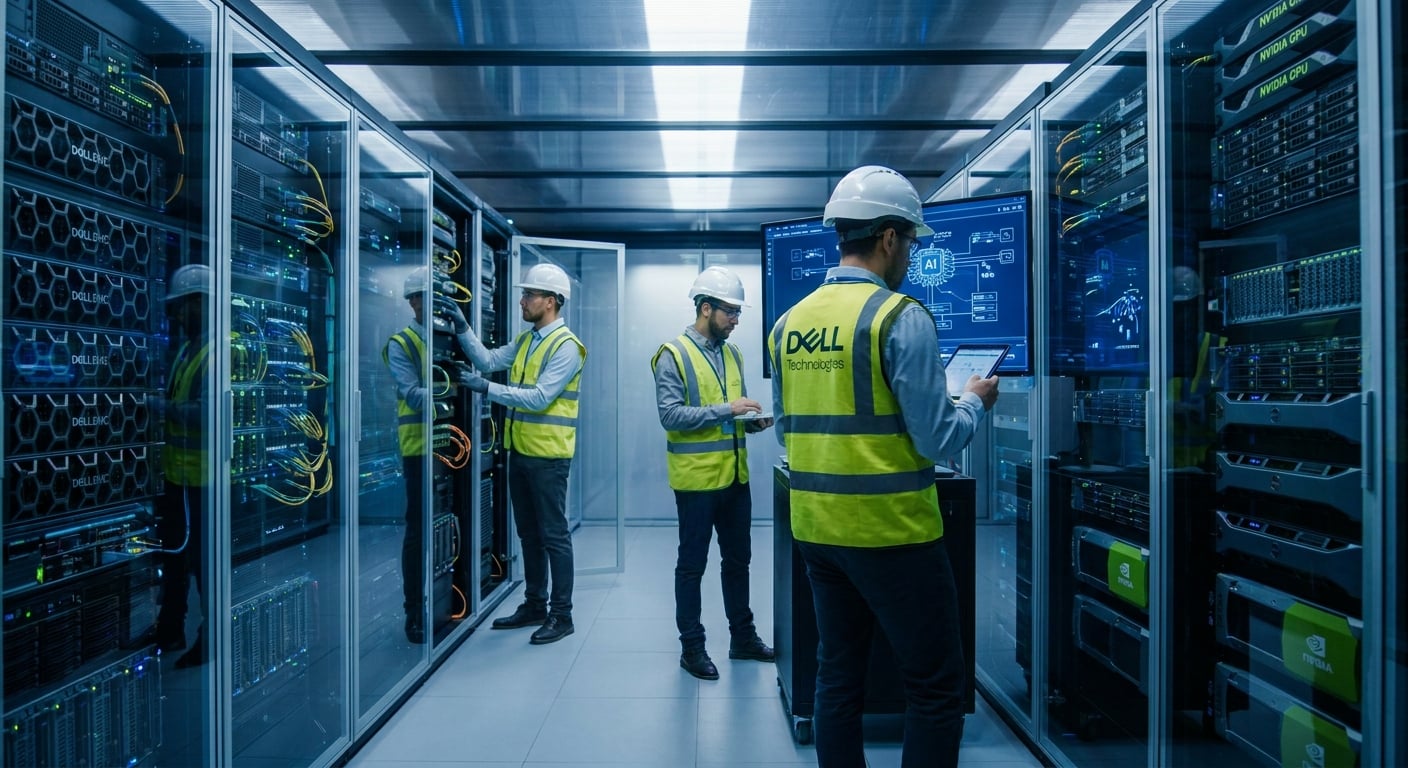
Dell Technologies redefines the modern data centre in the age of artificial intelligence
Dell Technologies" announcement highlights the importance of AI data centers for modern e-commerce. Data centers are no longer just "back-office costs" but operational cores that impact the speed of product offerings, demand forecasting and transaction protection. Strategic management of AI infrastructure is critical to the competitiveness and efficiency of e-commerce businesses.
AI data center doesn't just mean more servers: it means a better infrastructure for data, security and speed of decisions. Dell Technologies' announcement of the modern data center in the age of AI is a useful starting point for any e-commerce company looking to leverage AI without disproportionately increasing cost and risk.
AI data center: why Dell's announcement is directly relevant to modern e-commerce
Dell Technologies« recent announcement »Dell Technologies Reimagines the Modern Data Center for the AI Era“ is not just another product update for servers, storage and data protection. It is a clear signal to enterprises that the era where the data center was treated as a ”back-office cost" is ending. In the AI era, the AI data center is becoming an operational core of growth: it affects the speed at which an e-commerce site recommends products, predicts demand, protects transactions, analyzes customer behavior, and supports real-time marketing automation.
For an e-commerce owner, it's not a question of whether to buy specific Dell PowerEdge systems or whether to immediately move all workloads to a hybrid cloud. The critical question is more strategic: can the current business infrastructure support AI workloads without disproportionately increasing cost, complexity and risk? When Dell talks about redesigning the modern data center, it refers to an architecture where compute, storage, data protection, edge computing and cyber resilience work as a single ecosystem. This is particularly relevant for e-commerce businesses that already have multiple data sources: ERP, WMS, CRM, e-shop platform, marketplace connectors, analytics, loyalty apps, customer support and advertising platforms.
The move comes at a time when the adoption of artificial intelligence is accelerating. According to McKinsey, the percentage of organisations using AI rose to 72% in 2024, while regular use of generative AI in at least one business function rose to 65%. This means that the conversation is no longer about experimentation in small pilots, but about productive enterprise AI deployments that need to be reliable, secure and measurable. As shown in the graph below, the adoption curve has entered an acceleration phase.
AI Adoption Acceleration and Generative AI
Source: McKinsey, The State of AI in Early 2024
Organisations using AIRegular use of generative AI
2023
55%
2024
72%
2023
33%
2024
65%
What is changing in the modern data center for the age of artificial intelligence
Dell is positioning the modern data center around three key pillars: computing power for AI, data storage that can serve large and heterogeneous datasets, and business continuity protection against cyber threats. At the compute level, solutions such as Dell PowerEdge servers are designed to support demanding AI workloads, from training and fine-tuning to inference performance for user-responsive applications. At the storage level, families such as Dell PowerStore and Dell PowerScale emphasize performance, scalability and data management that may reside on-premise, in the cloud or at the edge. At the security level, data protection and cyber resilience technologies are taking a prominent role because the data powering AI models is now a critical business asset.
For e-commerce, this change translates into practical needs. A recommendation engine that leverages purchase history, session behavior and products in stock cannot be delayed. A dynamic pricing system can't work with last week's data. A demand forecasting model needs clean, accessible and secure data from multiple sources. An AI assistant for customer support needs to have access to returns policies, orders, availability and contact history without exposing personal data. In other words, the AI data center is not just about IT. It's about conversion rate, customer experience, operational margin and brand trust.
At the same time, the transition doesn't mean that every business has to abandon the cloud or move everything on-premise. The trend is hybrid. According to Gartner, global end-user spending on public cloud services is estimated to reach $723.4 billion in 2025, up from $595.7 billion in 2024. This shows that the cloud continues to grow, but enterprises need a more mature strategy for which workloads run in the cloud, which ones near data, and which ones on specialized AI infrastructure. The chart below captures the growth in public cloud spending.
How the AI data center is linked to revenue, customer experience and operational efficiency
The value of an AI data center for a merchandising business is seen when it is connected to real use cases. In merchandising, AI can analyze sales patterns and help the team understand which products need to be promoted, which need better content and which create low margin. In performance marketing, models can improve audience segmentation, budget allocation and creative testing. In customer service, a well-trained assistant reduces repetitive tickets and increases speed of response. In operations, inventory forecasting reduces stockouts and overstocks, two problems that eat into profitability in different ways.
The point that is often underestimated is that all of this depends not just on the AI model, but on where the data is located, how fast it moves, who has access to it and how secure it is. If product data is inconsistent, if orders are stored in isolated systems, if returns are not linked to campaigns or if inventory is updated late, then even the most sophisticated generative AI will deliver mediocre results. Data center modernization is about exactly this transition: from fragmented technology islands to an infrastructure that serves data pipelines, analytics and automation with stability.
For medium and larger e-commerce businesses, AI infrastructure decisions need to be made on a commercial basis. It is not enough to have the technical capability to use GPU servers or cloud AI APIs. It is necessary to evaluate the total cost per use case, speed of implementation, latency, compliance requirements, privacy and scalability during peak periods such as Black Friday, Christmas or large seasonal campaigns. An AI data center that is properly designed is not “seen” by the end customer, but is felt through quick searches, relevant recommendations, consistent product availability and reliable service.
Step-by-Step guide: how to assess the readiness of your business
The first step is to map the data. Record where the key datasets are located: products, customers, orders, returns, inventory, suppliers, advertising costs, user behavior, reviews and support tickets. For each source, note owner, update frequency, data quality, format, API availability and access restrictions. If at this stage you discover that the marketing team doesn't trust the ERP data or that support sees a different order view from the e-shop, then the problem is not yet AI. It's the database and its governance.
The second step is the selection of use cases with clear business value. Instead of starting generically with “we want AI”, select three applications that can be measured. Examples: increase conversion rate through personalized recommendations, reduce support costs through AI assistant, improve forecast accuracy for inventory, or reduce returns through better product-customer matching. For each use case define baseline, KPI, required data, technical dependencies and potential risk. This practice protects the business from expensive implementations that impress in demos but do not improve financial results.
The third step is to decide on the architecture: cloud, on-premise, edge or hybrid cloud. For workloads that require rapid experimentation, the cloud may be ideal. For highly sensitive data or workloads with predictably high consumption, a more managed infrastructure may be economically and operationally better. For stores with physical points of sale, warehouses or logistics hubs, edge computing can reduce latency and enable local decisions such as real-time inventory validation or computer vision applications. The logic is not “one model for everything”, but proper placement of each workload where it performs best.
The fourth step is the preparation of security and data protection before production operation. AI systems increase both the value and exposure of data. Access policies, logging, backup, recovery testing, encryption, data retention and incident response procedures are needed. Cyber resilience is not just firewall or antivirus. It's the ability of the business to continue operating when something goes wrong: ransomware, human error, provider outage, integration failure or wrong output from an AI model. This is where the data protection solutions that Dell highlights in its announcement are directly linked to business continuity.
The fifth step is the implementation of a pilot with a limited scope and a clear duration. Choose a use case, a dataset, a small set of users and a specific KPI. For example, apply personalized recommendations to a product category for 8 weeks and compare conversion rate, average order value and click-through rate with a control group. Or test AI assistant only for questions about shipments and returns, with the goal of reducing tickets reaching an agent. At the end of the pilot, the expansion decision should be based on data, not enthusiasm.
The sixth step is escalation with governance. When a use case is performing, create processes for model monitoring, data quality checks, cost control and security review. Experience shows that AI projects fail most often not because the model is not “smart” enough, but because there is no operational framework around it. A mature AI data center must support repeatability: being able to add new use cases without rebuilding the infrastructure from scratch each time.
KPIs, costs and risks that management needs to monitor
The management of an e-commerce brand does not need to go into every technical detail, but should monitor specific indicators. In terms of commercial performance, the key KPIs are conversion rate, average order value, revenue per visitor, repeat purchase rate, customer lifetime value and gross margin. At the operational level, forecast accuracy, order fulfillment time, stockout rate, return rate and cost per ticket are of interest. At the technology level, latency, uptime, cost per inference, cost of storage, recovery time and number of security incidents should be measured.
A common mistake is that companies only see the initial infrastructure costs and not the total life cycle costs. AI infrastructure has costs in compute, storage, data engineering, security, monitoring, human training and maintenance. On the other hand, not investing at all can cost more through slow processes, poor personalization, weak inventory forecasting and lower competitiveness. The right approach is business case by use case: what problem are we solving, how much is it worth, how much does it cost, when do we break-even and what is the risk if it fails.
There is also the issue of vendor strategy. Dell's announcement shows that large technology providers are investing in end-to-end AI solutions, but an enterprise must avoid both over-reliance on one vendor and over-diversification. The balance lies in open architectures, pure APIs, documented processes and data portability. For e-commerce businesses working with agencies, ERP vendors, hosting providers and logistics platforms, this flexibility is practically essential.
The practical conclusion for e-commerce owners
The message behind Dell's move is clear: AI cannot rely on infrastructure designed for a simpler digital age. The AI data center is the foundation on which the next competitive advantages in e-commerce are built. It is not just about large multinationals. It's about any business that wants to use data for better decisions, faster service, smarter marketing and greater resilience.
The right starting point is not the technology market, but the strategic mapping of data and commercial objectives. That's where the decision on AI infrastructure, hybrid cloud, GPU servers, storage, data protection and cyber resilience starts. Businesses that move methodically will be able to leverage AI not as a piecemeal tool, but as an organized capability that improves every critical point of the commercial operation. And that's the real meaning of the modern data center in the age of AI: less technological complexity, more business speed and better customer experience.
Frequently asked questions about AI data center in e-commerce
What does Dell's announcement mean for modern e-commerce?;
Dell's announcement highlights the importance of the AI data center as an operational core for e-commerce development, impacting product recommendation speed, demand forecasting and transaction security.
How does the AI data center affect the customer experience in e-commerce?;
The AI data center improves the customer experience through personalized recommendations, fast service and consistent product availability, boosting conversion rate and customer satisfaction.
Why is a hybrid cloud strategy important for enterprises?;
A hybrid cloud strategy allows enterprises to leverage the advantages of the cloud for rapid experimentation and cost-effectiveness while maintaining control over sensitive data and specific workloads.
What are the key elements of an AI data center according to Dell?;
Dell is positioning the AI data center around computing power, large datasets storage and data protection, creating an integrated ecosystem for business growth.
How can a business assess its readiness for AI?;
An enterprise needs to map its data, select strategic use cases and decide on its infrastructure architecture, taking into account costs, security and business value.
What are the risks and costs that administrations need to monitor?;
Managements need to monitor KPIs such as conversion rate and latency, assess the total lifecycle cost of AI infrastructure, and manage risks such as security failures and attacks.