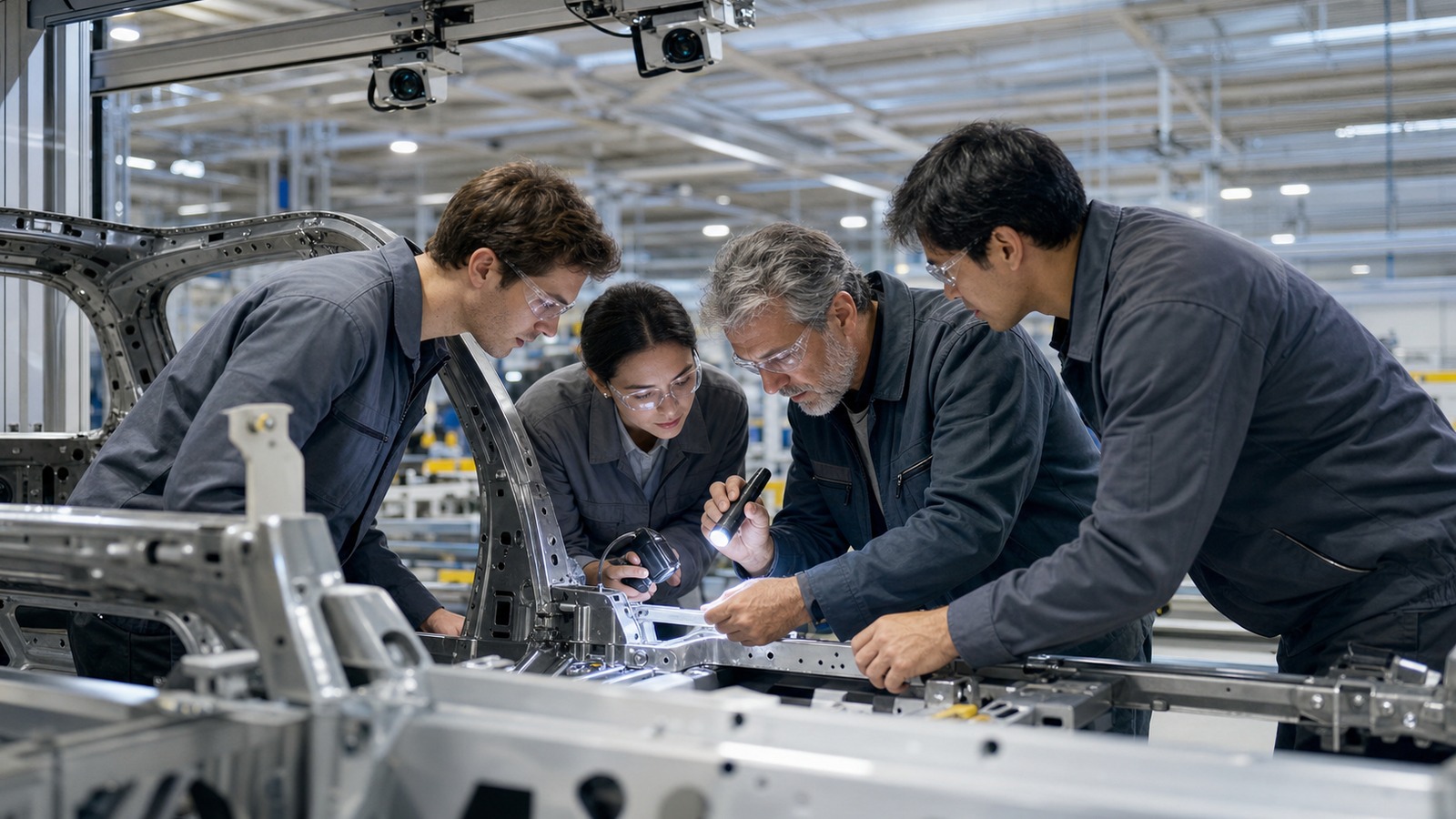
Short answer: The Ford case shows that AI improves quality when it functions as an early-warning mechanism rather than as a substitute for technical judgment. The company combined the expertise of more than 350 experienced technical specialists with mandatory peer reviews and machine vision or pattern recognition tools.
The measurable result is specific but requires careful reading: in J.D. Power’s 2026 Initial Quality Study, Ford ranked first among mass-market brands with 152 problems per 100 vehicles. The ranking confirms an improvement in initial quality; it does not, in and of itself, prove that a single algorithm or organizational change was solely responsible for the difference.
For a digital business, a useful approach is to link each AI alert to a domain expert, with clear authority to intervene and a closed-loop verification process. This way, data is turned into a decision before an error reaches a large number of customers.
It all started with a disciplinary issue, not a lack of software
Ford’s vice president of engineering, Charles Poon, described the previous situation as a set of issues stemming from inconsistent discipline in problem-solving. He also cited a loss of expertise that had occurred three or four years earlier. This diagnosis is significant: the company did not present the problem simply as a lack of data or a flawed algorithm, but as an organizational weakness in the process by which failures are identified, examined, and resolved.
The solution was to bring the accumulated expertise back to the decision-making level. The 350 senior engineers—including some who had retired—took on the role of expert troubleshooters and consultants. They were not brought in merely as a token committee. Their mission was to help younger engineers review designs, identify weaknesses, and conduct the necessary technical analysis.
The red teams incorporated skepticism into the process
Ford compares these experts to red teams. They look at a component and ask how it might fail. They examine the choice of materials, the dimensions, and the reasoning behind minor design decisions. Poon gave the example of asking why a radius is two millimeters instead of two and a half. This detail shows that the review isn’t limited to a general «it looks right,» but requires documentation of the choice.
Five or six specialists may be involved in fuel systems, while the design is presented by a team of two or three design engineers. The reviewers are knowledgeable about tanks, fuel vapors, material interactions, injectors, pumps, software, and control strategies. This is critical for any business: meaningful reviews require people who understand the interdependencies, not just a checklist.
What to keep: Ford’s AI handles large-scale tasks—consistent visual inspections and anomaly detection — while experienced reviewers ask the right questions, confirm the root cause, and determine the appropriate course of action.
AI acts as a sensor for human judgment
The article makes it clear that tools complement engineers rather than replacing them. An iPhone-based system at the Kentucky Truck Plant checks wire connections and the installation of critical bolts while these points are still accessible for correction. If a bolt is found on the floor, the technician can photograph it, and the system compares it to the vehicle’s parts list to determine where it belongs.
The value here isn't the impressive interface. The same principle applies when a team designs workflow automation using artificial intelligence: The alert must reach the person who can take action in a timely manner. It involves shifting control to the moment and location where a correction can be made at the lowest cost. In e-commerce, the equivalent would be a tool that flags an unusual drop in checkout completion rates or incorrect product mapping before the problem escalates. The tool does not determine the business cause on its own; it simply provides the person in charge with a specific alert to investigate.
Four layers of a reliable quality workflow
Hundreds of thousands of traces require both machines and people
According to Poon, hundreds of thousands of time series of pressure, force, velocity, and torque are collected in a single day during transmission functional tests. It is difficult for a person to reliably examine such a large volume of data. Machine learning looks for small deviations and alerts engineers to which specific component requires attention.
The example given is particularly instructive: a minor anomaly led to a disassembly, during which a contamination was found that had blocked a hydraulic passage and was causing slightly higher pressure. The AI did not «diagnose» the entire cause as if by magic. It flagged the outlier; the technical team followed up on the finding, opened up the system, and confirmed the physical cause.
From design to service, the same brand must be consistent
This approach is not limited to the production line. Poon discusses the application of tools during the design phase, the manufacturing phase, and the service phase. This continuity allows an organization to view quality as a cycle: feedback from the service phase can inform the design phase, a finding from the production phase can change quality control procedures, and a design choice can lead to a specific test.
For a digital business, this means linking data from ads, the website, checkout, customer support, and returns. The source does not claim that Ford uses this marketing model; it is a business analogy. The safe conclusion is that value increases when data points are not trapped in separate silos.
In-house technology meets specific needs
Ford uses both commercially available tools and its own solutions. Poon mentions in-house neural-network machine-learning algorithms for pattern recognition and predictability, generative AI for creating geometries and optimization, as well as agentic AI that supports peer reviews. He emphasizes that many applications require specialized training and development due to their unique nature.
This does not mean that every company must build its own model. It does, however, point to a selection criterion: the more closely an application is tied to proprietary data, critical processes, and domain knowledge, the more carefully its customization, evaluation, and human oversight must be designed. A general-purpose chatbot is not equivalent to a control system trained to detect specific anomalies.
The cultural shift was part of the technical system
One of the source’s strongest observations concerns how the company handles failures. Poon says that the company now celebrates the discovery of failures and the early detection of anomalies, whereas in the past such a finding might have been perceived as a weakness. Without this change, even the best monitoring can fail: people will be motivated to hide a signal or downplay it.
Psychological and organizational safety are not referred to here as abstract values. They are linked to specific behavior: identifying the problem early, reporting it, reviewing it with experts, and correcting it. For marketers and business owners, the corresponding practice is not to label every negative outcome as «bad luck,» but to use it as a starting point for reviewing the campaign, the message, the funnel, or the customer experience.
The authority of reviewers is just as important as their knowledge
Technical specialists hold senior leadership positions and, according to the article, have the authority to take the necessary actions. This detail distinguishes a true governance model from a consultative workshop. If a reviewer can identify a risk but cannot require an analysis or a change, their insight has no practical impact.
As the Failures of Operational AI Automation Systems, an effective AI workflow requires clearly defined roles: who reviews the alert, who verifies the cause, who approves the change, and who monitors whether the correction was effective. The source does not provide a general organizational chart for other companies, but its model highlights the relationship between expertise, authority, and execution.
What we can—and cannot—conclude from the ranking
Design News notes that one might disagree about exactly what the Initial Quality Study measures. At the same time, it describes Ford’s rise from the bottom of the rankings to the top within just a few years as a genuine achievement and notes that the company itself attributes the improvement to its experienced engineers and tools. The distinction is crucial: we have a documented ranking and a corporate interpretation, not experimental proof that every improvement was caused by a specific factor.
That is why business analysis must remain cautious. We do not simply copy a 350-person structure just because it worked on a different scale. We stick to verifiable principles: drawing on experience, independent scrutiny, tools for large volumes of data, human verification, and a culture that rewards early discovery.
Four documented scale points
The figures are sourced from J.D. Power and from statements by Ford published in June 2026. They describe the company’s specific situation and do not serve as a general benchmark for every AI project.
350+experienced experts
Ford said it has hired more than 350 technical specialists to work with younger teams and AI tools.
33factories
The optical inspection system was reported to be installed in 33 production facilities worldwide.
1000+cameras
More than 1,000 cameras were performing millions of inspections on production lines.
152 PP100original quality
Ford's performance in the 2026 J.D. Power study, where a lower PP100 score indicates fewer reported problems.
The Criteria for a Digital Business
Don't buy «AI for quality» without defining the checkpoint, the reviewer, and the decision that follows.
A proper pilot study measures whether the problem was detected earlier, whether the cause was confirmed, whether recurrence was reduced, and whether the team can explain why the intervention was carried out — not just how many alerts were generated.
A Practical Framework for Marketing and E-Commerce Teams
A team can start by identifying three things: the points where a mistake becomes costly, the people who recognize the early warning signs, and the data that is currently too voluminous to check manually. Then, it can conduct a small red-team review before critical launches, involving people from performance, content, analytics, customer service, and operations where relevant.
AI can be used to identify outliers, inconsistencies, and recurring patterns, but every alert requires an owner and a verification process. This is the same criterion required by the Evaluation of AI agents based on actual deliverables: Speed without documented quality is not enough. The team must also document what was found, what the actual cause was, and what changes were made as a result. This way, the experience isn’t confined to one person’s mind, and the evaluation model or rule can be improved based on actual events.
Finally, the KPI shouldn’t just be «how many alerts the AI generated.» More meaningful questions are whether problems were detected earlier, whether their recurrence has been reduced, and whether reviewers can explain why an intervention was made. These are recommended implementation principles derived from the case study, not metrics published by Ford.
Six Steps to a Quality Loop in Marketing and E-Commerce
- Step 1Pinpoint the exact point of failure
Select a specific issue, such as an incorrect price, a product mapping error, a checkout failure, or an inconsistent support response.
- Step 2Here is the earliest detectable signal
Record which data points appear before a large number of customers are affected, and determine what threshold should trigger an alert.
- Step 3Install Domain Reviewer
Assign the alert to the person who understands the process, the edge cases, and the cost of a false positive or false negative.
- Step 4Grant clear authority to act
The reviewer must be able to pause a campaign, feed, release, or automation and request a documented correction.
- Step 5Record the confirmed cause
Link the alert to the actual incident, the decision, and the outcome, so that the knowledge isn't confined to just one person's mind.
- Step 6Update a rule, test, or model
Convert the confirmed cause into a new test and measure detection time, recurrence, and business impact.
The competitive advantage lies in the composition
The Ford case does not support the «human or AI» dilemma. It supports a complex system: experienced people formulate difficult questions, junior engineers document decisions, sensors and tests generate data, machine learning highlights anomalies, and teams confirm the physical cause. Generative and agentic AI are added as additional layers of support, not as a substitute for accountability.
For any business seeking results from AI, the message is straightforward: don’t start with the tool. Start with the point of failure, the knowledge needed to identify it, and the process that enables you to take action. Then technology can reveal what humans can’t see in time—and humans can understand what it means.
Business Automation & AI by TWO DOTS
Design AI workflows that identify problems and lead to controlled action.
TWO DOTS maps data, alerts, human checkpoints, acceptance criteria, and monitoring for automation in e-commerce, marketing, and support, ensuring that speed does not come at the expense of quality.
Frequently Asked Questions (FAQs)
How many experienced specialists did Ford bring on board?;
Ford said it has hired more than 350 experienced technical specialists to work alongside younger teams, conduct peer reviews, and improve AI-based quality tools.
Has AI Replaced Ford's Engineers?;
No. Ford’s public description presents AI as a tool for consistent inspections and pattern detection, while humans ask the right questions, confirm the cause, and decide on the corrective action.
How do red-team reviews affect quality?;
They examine how a design might fail, question materials, dimensions, and assumptions, and request documentation before the decision moves on to the next phase.
How is machine vision used on the production line?;
Cameras and machine learning monitor critical connections or components and alert the operator as long as the location remains accessible for immediate correction.
What does J.D. Power's 152 PP100 measure?;
This translates to 152 reported problems per 100 vehicles during the first 90 days of ownership for Ford in the 2026 study. A lower PP100 indicates better initial quality.
Does the ranking prove that AI caused the improvement?;
Not on its own. The ranking substantiates the result, while the connection to experienced reviewers and AI tools is the company’s own interpretation and needs to be presented with that caveat.
What is the equivalent model for e-commerce?;
A system that detects anomalies in prices, feeds, checkout, or support in a timely manner sends an alert to the specific domain owner and records the confirmed cause before updating the rule or model.
Which KPIs indicate that an AI quality workflow is effective?;
Useful KPIs include time to detection, the percentage of confirmed alerts, reduction in recurrence, impact on customers, and the team’s ability to explain each intervention.