With over 20 years of experience, we transform your digital presence. We specialize in website and E-Shop development, SEO and Digital Marketing, ERP software and smart automation that take your business to the next level.
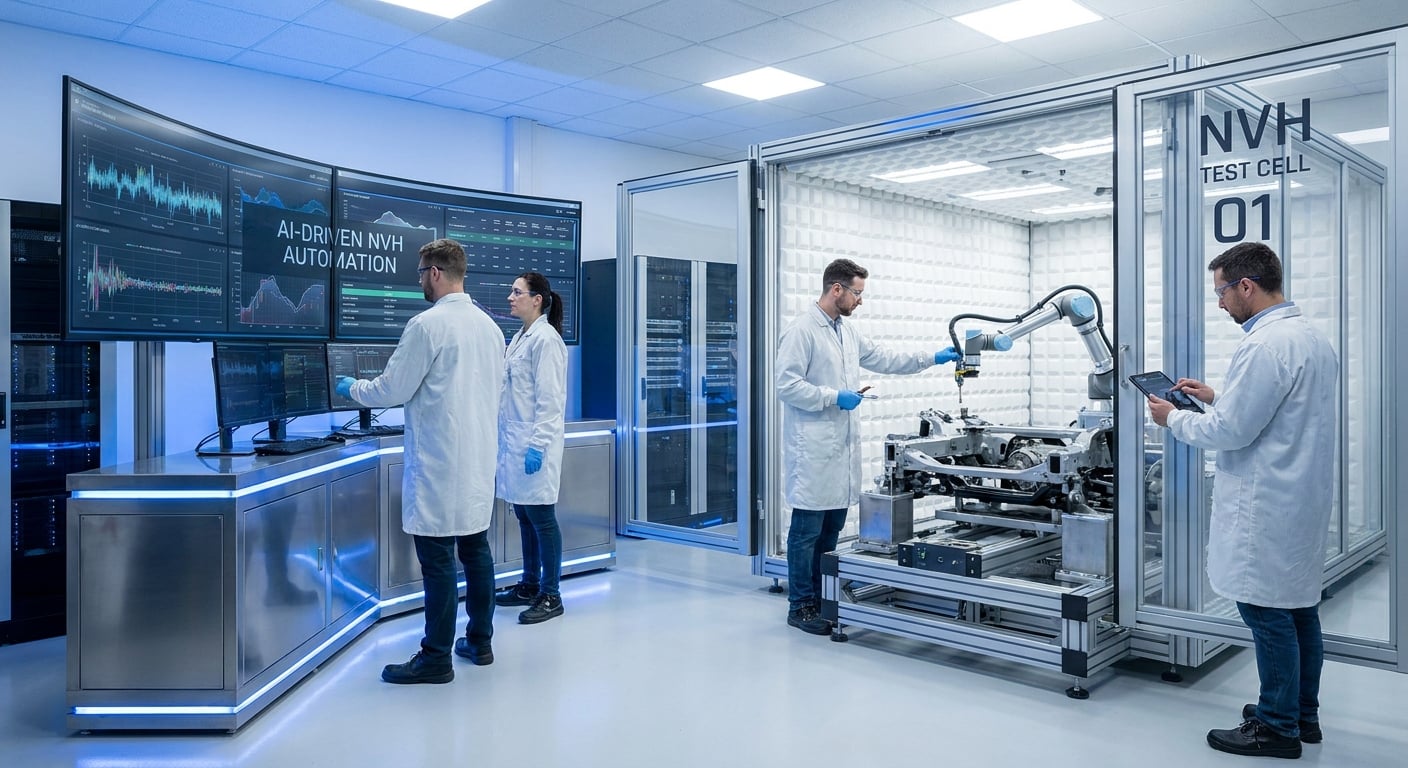
Artificial intelligence and automation pave the way for smart NVH testing with fewer engineers
The Design News article analyzes how artificial intelligence and automation are revolutionizing NVH testing and offers valuable lessons for e-shops. It focuses on the importance of data-driven decisions to improve customer experience and increase profitability. Through automated checks, predictive analytics and AI testing, e-shop owners can reduce errors, improve processes and gain a competitive advantage in the market.
Design News’ article on how AI and automation are changing NVH testing, or noise, vibration, and harshness testing, in industrial and automotive environments, has more value for e-commerce owners than it might seem at first glance. On the surface, it talks about engineers, sensors, acoustic measurements, and systems that allow smaller teams to perform more complex tests. In practice, however, it describes a very important business shift: companies can no longer rely on just more people to manage more complexity. They need systems that collect data, recognize patterns, spot anomalies, and help people make better decisions faster.
This is exactly what happens in e-commerce. A modern e-shop has to control loading speed, product availability, feeds to marketplaces, prices, coupons, conversion funnels, checkout errors, returns, reviews, advertising costs, warehouse and customer experience. When all of this is checked manually, errors usually become visible when turnover has already been lost. Artificial intelligence is not just a content production tool or a chatbot. It is a way to build a functional «listening system» for the e-shop, similar to NVH systems that listen and analyze the noise of a product before it is released to the market.
For an e-commerce owner, the critical question is not whether to adopt AI, but where to implement it first to achieve real business benefit. The answer lies in the areas where there is repetitive work, large volumes of data, and high cost of error. This is where automation, AI testing, anomaly detection, and predictive analytics can serve as practical tools to reduce costs, improve customer experience, and increase profitability.
From the lab to eCommerce: the value of data-driven decisions
In NVH testing, engineers don’t just rely on the subjective feeling that a sound is «good» or «annoying.» They need data, repeatability, comparable measurements, and automated processes that reduce the chance of human error. The same goes for an e-shop that wants to grow in a healthy way. It’s not enough to just look at total sales at the end of the month. You need to know which product category has increased returns, which checkout step creates friction, which campaign brings in revenue but low profit margin, and which products have demand that can be predicted before the stock runs out.
Data-driven decisions in e-commerce don’t mean the owner loses control. On the contrary, they gain a better picture of what’s really going on. Artificial intelligence can analyze patterns that are difficult to detect manually: repeated complaints about a particular product line, an unusual drop in conversion rates on mobile devices, fulfillment delays in specific regions, or a sudden increase in cancellations after a shipping policy change. The value is not only in the analysis, but in early notification. The earlier a problem is identified, the lower its cost.
The European market shows that the adoption of AI by businesses is accelerating. According to Eurostat, the percentage of businesses in the EU with 10 or more employees using AI technologies increased from 8.0% in 2023 to 13.5% in 2024. For e-shops, this is not just a technological trend. It is a sign that competition will gradually operate with better analysis tools, faster controls and smarter resource allocation. As the graph below shows, the rise is significant in just one year.
Businesses using AI
2023
8
2024
13.5
Where is artificial intelligence practically applied in an e-shop?
The most practical application of artificial intelligence in an e-shop starts with automated checks. Just as an industrial product is tested for noise and vibration before it reaches the end user, an online store must be constantly checked for technical and commercial deviations. AI testing can identify broken links, problems on product pages, inconsistencies in prices, incorrect availability statuses, errors in feeds and checkout malfunctions. These are not «small bugs». During periods of high demand, such as Black Friday, Christmas or sales, a technical error can translate into lost orders and increased support costs.
A second area is product testing. In e-commerce, the product is not just the physical object. It is the photo, the description, the price, the size, the availability, the reviews, the return policy and the way it is presented. With machine learning, an e-shop can analyze which product pages have a low conversion rate in relation to their traffic, which products are often added to the cart but not purchased and which features affect returns. This knowledge helps in better prioritization: instead of changing dozens of pages at random, it starts with those that have the greatest possibility of immediate improvement.
The third area is the quality of customer experience. Artificial intelligence can group support tickets, identify recurring issues, detect negative sentiment in reviews, and help the customer care team respond faster and more consistently. Here, automation should not be seen as a replacement for human service, but as a prioritization filter. Simple questions can be answered immediately, while more complex cases can be passed on to a human with a complete history and correct categorization.
Finally, predictive analytics and supply chain optimization are especially important for e-shops with large catalogs or seasonality. Demand forecasting can reduce stockouts, excess inventory, and last-minute impulse purchases. When sales data is combined with promotional pressure, seasonality, pricing changes, and returns history, the owner gains a much better picture of where to commit capital and where not to.
Step-by-Step guide to implementing AI automation in your e-shop
The first step is to map out your repetitive tasks. List the processes your team performs daily or weekly: inventory checks, price updates, answers to frequently asked questions, order tracking, reporting, product changes, campaign monitoring, and cross-referencing across ERP, e-commerce, and advertising channels. Next to each process, note how long it takes, how often it generates errors, and what the potential financial cost is when something goes wrong. This exercise often reveals that the best opportunities lie not in the most impressive AI projects, but in the most boring and repetitive parts of daily operations.
The second step is to choose a narrow use case with a clear goal. For example: reducing time to detect technical errors, improving conversion rate optimization in a specific category, responding to tickets faster, predicting demand for top products, or automatically detecting anomalies in daily sales. A common mistake is trying to apply AI to everything at once. Instead, the right approach is to pilot: one problem, one data set, one person responsible, one KPI, and a 30 to 60-day timeframe.
The third step is data purity. No e-commerce automation solution can perform if product data is inconsistent, categories change without rules, returns are not recorded with the right justification, or marketing channels are not tracked consistently. Before investing in AI, make sure that the basic data is structured: SKUs, categories, prices, margins, availability, shipping costs, order source, return reason, and order status.
The fourth step is to automate alerts, not just create reports. A report that is read every Friday may be useful, but it does not prevent damage that began on Monday. Set alerts for critical deviations: a sudden drop in conversion, an increase in failed payments, an unusual increase in returns, products with high traffic and zero sales, campaigns with costs that increase without corresponding orders. Here, anomaly detection has immediate value, because it does not wait for the human to look for the problem. It brings it to them.
The fifth step is to evaluate with business indicators. Don’t judge an AI project by whether it «works technically,» but by whether it reduces costs, increases speed, reduces errors, or improves customer experience. Measure time saved, ticket reduction, conversion rate increase, returns reduction, stockout reduction, and margin improvement. This is how AI stops being an experimental tool and becomes part of business performance.
Why AI adoption is becoming a competitive advantage
The global picture shows that AI adoption is no longer a regional option. According to McKinsey’s global survey for 2024, 72% of organizations said they are using AI in at least one business function, up from 55% in 2023. For an e-commerce owner, this means the market is moving towards an environment where speed of analysis and reaction will play an increasingly important role. The difference will not only be who has the best products, but who identifies problems faster, who predicts demand better and who offers the most consistent customer experience.
Organizations using AI in at least one function
2023
55
2024
72
The important thing is that the advantage does not belong exclusively to large companies. Small and medium-sized e-shops can move faster, precisely because they have less bureaucracy. A well-established system of automated checks, an AI-assisted customer support workflow, a demand forecasting model for the top 50 products or a mechanism for detecting technical errors can make a substantial difference without requiring a huge team. The lesson from NVH testing is clear: when technology takes over the collection, comparison and initial interpretation of data, expert people can focus on decisions that require judgment.
This is especially important in an era where many e-shops operate with limited teams. The same person can manage products, orders, suppliers, social media and advertising. Artificial intelligence does not solve the lack of time on its own, but it can significantly reduce the noise. It can distinguish which issues need immediate attention and which can wait. In other words, it turns information into a priority.
How to get started without getting lost in the complexity
The safest strategy is to start from a point with a measurable pain point. If your e-shop is losing sales at checkout, start with technical monitoring and AI testing on critical purchase paths. If you have a lot of tickets, start with question categorization and suggested answers. If you have frequent out-of-stock on best sellers, start with predictive demand analytics. If returns are increasing, analyze products, descriptions, sizes, photos and return reasons. Choosing the right use case reduces risk and makes it easier to prove ROI.
At the same time, attention needs to be paid to the human side. Automation fails when it is imposed without explaining to the team what is changing and why. The goal is not to replace people who know the market, products and customers. The goal is to get rid of low-value tasks and have better data to do their job. In practice, the best AI implementation comes when three elements come together: clean data, clear business priority and people who leverage insights responsibly.
For TWO DOTS, the conversation around artificial intelligence in e-commerce is not theoretical. It is about how an e-shop is designed, how its data is organized, how performance is measured, and how an experience is built that stands up to real-world market conditions. Just as engineers use smarter systems to test products with fewer resources, e-commerce teams can use AI to identify problems before they become losses, improve processes before they become bottlenecks, and invest time where there is real business value.
Conclusion: less noise, better decisions
The key takeaway from the Design News article is that AI and automation aren’t limited to flashy high-tech applications. Their real power lies in everyday operational improvement: less manual testing, faster detection of deviations, better utilization of expert people, and data-driven decisions. For an e-shop, this translates into a better customer experience, more consistent sales, a clearer inventory picture, more effective campaigns, and greater resilience in times of stress.
Artificial intelligence doesn’t have to start as a big digital transformation project. It can start with an automated audit, an alert, a prediction, or better data classification. The key is to connect it to a real business problem. When done right, AI stops being a buzzword and becomes a practical system that helps e-shop owners listen better to their business, separate useful noise from dangerous noise, and move faster than the competition.
How can artificial intelligence improve the operation of an e-shop?;
Artificial intelligence can automate audits, identify errors in products, checkouts, and feeds, analyze sales data, and help the team prioritize issues that directly impact revenue and customer experience.
What is the importance of data-driven decisions in e-commerce?;
Data-driven decisions help an e-shop base its decisions on real patterns, not just intuition. This way, it can identify declining conversion rates, availability issues, increased returns, or demand opportunities before costly losses occur.
What is the first step in implementing AI automation in an e-shop?;
The first step is to choose a specific, measurable problem. For example, technical monitoring at checkout, analysis of support tickets, forecasting demand for best sellers, or identifying anomalies in daily sales.
Why is AI adoption a competitive advantage for e-shops?;
Because it reduces problem detection time, improves data utilization, and allows for faster response to changes in demand, costs, and customer behavior, an e-shop that sees market signals earlier can move faster.
How can artificial intelligence improve the customer experience in an e-shop?;
It can identify recurring complaints, categorize tickets, suggest more relevant answers, identify problematic product pages, and help the team fix friction before they affect more customers.